If Mount Tai, China is on your radar, you’re already looking in the right direction.
Maybe you’ve seen photos of that fiery Mount Tai sunrise, heard it called “The First of the Five Great Mountains”, or you’re planning a bullet-train getaway from Beijing, Shanghai, or Jinan. But once you start researching, the questions pile up fast:
- Should you hike all 6,000+ steps or take the Mount Tai cable car?
- Is a sunrise climb really worth the exhaustion?
- Where do you stay – in Tai’an city or in a summit hotel on top of Taishan?
- What does it actually cost in 2025 – tickets, buses, cable cars, hotels?
We’ve climbed Mount Tai (Taishan) more times than we can count, in every season and on every major route. In this guide, we’ll cut through the noise and show you exactly how to plan a smooth, unforgettable trip: from choosing the best hiking route and timing your sunrise perfectly, to booking trains, hotels, and tickets without stress.
If you want a clear, honest, and up‑to‑date 2025 game plan for experiencing Mount Tai, China at its best, you’re in the right place.
Why Mount Tai China Belongs on Your Shortlist
If you’re planning a trip to China and wondering whether Mount Tai is “worth it,” I’ll be direct: yes, absolutely. Out of all the famous mountains and temples in the country, Mount Tai China (Taishan Mountain) is where Chinese history, religion, and everyday life actually meet. It’s not just a pretty hike; it’s a living symbol of Chinese civilization.
I’m based in Shandong and we’ve helped a lot of international travelers plan their first Mount Tai climb. Almost all of them tell me the same thing afterward: “This is where China really clicked for me.” Here’s why.
Spiritual And Historical Heart Of China
For over 3,000 years, Mount Tai has been the place where emperors, philosophers, and ordinary people came to speak to heaven.
- Imperial mountain: More than a dozen emperors made pilgrimages here to perform “fengshan” ceremonies, asking Heaven to bless their rule. You’re literally walking the same steps emperors took.
- Three major traditions in one place:
- Confucianism (nearby Qufu is Confucius’s hometown)
- Taoism (temples and shrines along the trail)
- Buddhism (monasteries and statues on the slopes and summit)
You see all three on one mountain, in one day.
- Living culture, not a museum: Locals still climb to pray for exams, business, health, and family. You’ll see schoolkids, grandparents, and office workers climbing alongside you.
If you want more than just “nice photos,” Mount Tai gives you context: how Chinese people have thought about power, nature, and fate for thousands of years.
“First Of The Five Great Mountains” And Double UNESCO Site
In Chinese, Mount Tai is often called “The First of the Five Great Mountains” (五岳之首). That’s not marketing copy. It reflects real status:
- Spiritual ranking: Among the Sacred Mountains of China, Mount Tai sits at the top in terms of ritual importance.
- Double UNESCO World Heritage site:
- Cultural World Heritage – for its temples, stone inscriptions, imperial ceremonies, and deep connection to Chinese philosophy.
- Natural World Heritage – for its dramatic cliffs, ancient pines, and layered landscapes.
Plenty of mountains are beautiful. Very few are beautiful, sacred, and historically central at the same time. That’s Mount Tai’s edge.
Confucius, Modern Leaders, And Powerful Quotes
If you’re into history or philosophy, you’ll recognize Mount Tai from quotes long before you get there.
- Confucius and Mount Tai: He is said to have climbed here and declared something that’s often paraphrased as:
“When you stand on Mount Tai, all other mountains seem small.”
This isn’t just about scenery; it’s about perspective on life and ambition. - Ancient poets and scholars wrote endlessly about Taishan Mountain China as a symbol of stability, virtue, and the relationship between ruler and Heaven.
- Modern leaders have come here too, calling Mount Tai a symbol of the Chinese nation’s strength and spirit.
As you pass stone carvings and calligraphy on the steps, you’re not just reading “tourist slogans.” You’re walking through layers of political and philosophical storytelling written directly onto the rock.
Mount Tai vs Other Sacred Mountains (Huangshan, Hua Shan, Emei Shan)
People often ask me: “If I only have time for one mountain in China, should it be Huangshan, Hua Shan, Emei, or Mount Tai?” Here’s how I explain it:
-
Huangshan (Yellow Mountain):
- Probably the most photogenic, with crazy rock formations and seas of clouds.
- Very focused on landscape and photography.
- Less deeply tied to state rituals and Confucian culture than Mount Tai.
-
Hua Shan (Huashan):
- Famous for dangerous cliffside plank walks and adrenaline.
- Great if you’re into extreme edges and narrow paths.
- More of a thrill mountain; less central historically than Mount Tai.
-
Emei Shan (Mount Emei):
- One of the Four Sacred Buddhist Mountains, rich in Buddhist culture.
- Longer, more spread-out hike with lush forests and monkeys.
- Ideal for people focused mainly on Buddhist heritage.
-
Mount Tai (Tai Shan):
- Most important politically and culturally out of the group.
- Strongest link to Confucius, emperors, and mainstream Chinese history.
- Easier to access on high-speed rail between major cities like Beijing, Shanghai, Jinan, and Qingdao.
- A balanced mix of culture, religion, and accessible hiking.
If you want to understand how China sees itself, Mount Tai usually beats the others as a first choice, especially for a short trip.
Why International Travelers Add Mount Tai To Their China Itinerary
For US travelers and other international visitors, Mount Tai fits surprisingly well into a modern China route:
- Easy logistics:
- On the high-speed rail corridor between Beijing, Shanghai, Jinan, and Qufu.
- Simple to add as a day trip or 1–2 night stop in a longer itinerary.
- Powerful combo with Qufu and Jinan:
- Mount Tai for nature + imperial rituals
- Qufu for Confucius and classical philosophy
- Jinan for ancient springs and lakes
Together, they form a compact, meaningful Shandong Mount Tai trip.
- Authentic vibe:
- Fewer foreign tourists than Beijing, Shanghai, or Xi’an.
- You get more interaction with locals and a more grounded view of daily life.
- Flexible for all travelers:
- You can hike thousands of steps on a traditional Red Gate Mount Tai route,
- Or use the Mount Tai cable car and shuttle buses for a lighter climb.
- Works for families, first-time visitors, and even older travelers as long as you plan smart.
If you want a destination that combines scenery, culture, and real local life without adding complicated logistics, Mount Tai China is one of the smartest additions you can make to your 2025 itinerary.
Best Time to Visit Mount Tai China in 2025
If you’re planning a Mount Tai China trip in 2025, timing matters a lot—both for weather and crowds. Here’s how I’d plan it if I were flying in from the U.S. and wanted good views, a realistic climb, and minimal stress.
Mount Tai Weather by Season
Mount Tai (Taishan Mountain) is higher and cooler than nearby cities like Tai’an and Jinan, so always think “one layer colder” than the weather app shows for the city.
Spring (March–May)
- Pros: Comfortable for hiking, fresh air, blooming trees, less humidity.
- Cons: Early spring (March) can still be chilly and windy on the summit.
- Temps (rough guide):
- Base: 45–70°F (7–21°C)
- Summit: 35–60°F (2–15°C)
Summer (June–August)
- Pros: Long days, lush green, night climbs feel warm enough in a light jacket.
- Cons: Hot and humid at the base, storms and fog are common, peak crowds.
- Temps:
- Base: 75–95°F (24–35°C)
- Summit: 60–80°F (15–27°C)
Autumn (September–November)
- Pros: Best overall season—clear skies, stable weather, great sunrise odds, fall colors.
- Cons: Late October–November can be quite cold on top before sunrise.
- Temps:
- Base: 50–80°F (10–27°C)
- Summit: 40–65°F (4–18°C)
Winter (December–February)
- Pros: Very few tourists, dramatic snow scenes if you’re lucky.
- Cons: Cold, windy, icy steps, some services may reduce hours.
- Temps:
- Base: 25–45°F (-4–7°C)
- Summit: 10–35°F (-12–2°C)
For a quick visual feel of viewpoints and seasons, I like using a Mount Tai map and view guide before I lock in dates, such as this Mount Tai China map & viewpoints breakdown.
Crowd Levels and China Holiday Warnings
Mount Tai is one of the most famous mountains in China, so local tourism hits hard, especially during national holidays. As a U.S. traveler, these are dates I personally avoid:
Avoid if you can in 2025:
- Chinese New Year (Spring Festival): Late January / February (exact dates vary)
- Qingming Festival: Early April (tomb-sweeping holiday)
- Labor Day “Golden Week”: Around May 1–5
- National Day Golden Week: October 1–7 (the worst time for crowds)
On these dates you can expect:
- Extremely long lines for cable cars and shuttle buses
- Packed sunrise spots
- Higher hotel prices, especially on the summit
Weekends, especially sunny Saturdays from April–October, can also get crowded, but they’re still more manageable than Golden Week.
Best Months for Clear Mount Tai Sunrise Views
If “Mount Tai sunrise” is on your bucket list, focus on stable, dry-weather months:
- Best picks for clear sunrise (overall):
- Late September – mid-November
- Late March – May
These months usually offer:
- Decent visibility
- Less heavy summer haze
- Cooler but bearable pre-dawn temperatures
Foggy / lower-visibility periods:
- June–August: More humidity and thunderstorms = higher chance of clouds or zero-visibility sunrises
- Winter: Some crystal-clear days, but also gray, overcast stretches and serious cold
If you want to go deep into viewpoints and how sunrise actually looks from different peaks, this detailed Mount Tai sunrise and viewpoints guide is worth a look before booking.
Best Months in 2025: Hikers vs Casual Visitors
If you want to hike Mount Tai (Red Gate, many steps, real workout):
- Top months:
- April–early June 2025
- Mid-September–October 2025
- Why:
- Comfortable temps for 6,000+ steps
- Lower risk of heatstroke compared to summer
- Better grip on the steps (less rain than peak summer)
If you’re more casual (cable car + short walks):
- Top months:
- April–May
- September–October
- Also OK:
- June & November, if you don’t mind heat (June) or chilly wind (November) and are mostly using shuttle buses/cable cars.
I would skip for most first-timers from the U.S.:
- Peak July–August (hot + crowded, especially for kids or older travelers)
- Deep winter unless you’re experienced in cold-weather travel and have proper gear.
Weekend and Public Holiday Crowd Strategies
If your 2025 Mount Tai trip overlaps a Chinese weekend or holiday, you can still make it work with a bit of planning:
1. Choose the right day pattern
- If possible, visit on a weekday (Mon–Thu).
- If you must go on a weekend, aim for Sunday instead of Saturday.
2. Go very early or very late
- For day climbs:
- Be at the gate around opening time (often ~5:00–6:00 a.m. in peak season).
- For sunrise:
- Go up the afternoon/evening before, sleep on the summit, and you avoid the pre-dawn crowd crunch at cable cars and buses.
3. Use night climbing to your advantage (summer & holidays)
- In warmer months and busy periods, a lot of locals do a night hike:
- Start from Red Gate around 9–11 p.m.
- Reach the summit in 4–6 hours.
- Rest and wait for sunrise.
- It’s cooler, and while there are people on the trail, the biggest bottlenecks (ticket lines, buses) are largely avoided.
4. Buy tickets smart
- Use online booking platforms (like Trip.com for foreigners) when possible to skip on-site ticket confusion.
- On holidays, lines at the on-site windows get long; pre-booking helps you head straight to security/entry.
5. Eat and rest off-peak
- Avoid restaurants right at the most obvious entrances at noon and 6 p.m.—walk 5–10 minutes away, or eat early/late to dodge the worst congestion.
In 2025, if I were planning a “Mount Tai China travel guide–worthy” trip from the U.S., I’d lock in late April, May, late September, or October as my target months, aim for mid-week, and build the whole visit around one clear sunrise window.
How to Get to Mount Tai from Major Cities in China
Where Mount Tai (Taishan) Is and Why Tai’an Matters
Mount Tai (Taishan, 泰山) sits in the middle of Shandong Province, with Tai’an City spread out right at its base.
For trip planning, think of this as two key points:
- Tai’an city = your base camp (train stations, hotels, restaurants)
- Mount Tai scenic area = park entrance on the north side of the city
If you like to see the exact position and surrounding cities, this breakdown of the Mount Tai location in China is helpful when you’re mapping out your route.
High-Speed Trains to Tai’an from Major Cities
For US travelers, the easiest way is always high-speed rail. It’s fast, clean, and reliable.
Main stations to aim for:
- Tai’an Railway Station (泰安站) – on the Beijing–Shanghai high-speed line, best for long-distance trains
- Tai’an High-Speed Railway Station (泰安高铁站) – sometimes listed the same way in English apps
From Beijing to Mount Tai (Taishan):
- Route: Beijing South → Tai’an
- Time: about 2–2.5 hours on G/D trains
- Frequency: very frequent during the day
- Good for: same-day arrival and afternoon visit, or overnight in Tai’an
You can see more city-specific timing and options in this focused guide on how to get to Mount Tai from Beijing and other cities.
From Shanghai to Mount Tai:
- Route: Shanghai Hongqiao → Tai’an
- Time: about 3.5–4.5 hours
- Tip: choose morning trains so you arrive in Tai’an early afternoon
From Jinan to Mount Tai:
- Route: Jinan → Tai’an (both cities are on the same line)
- Time: 20–40 minutes by high-speed train
- This is the easiest “hub” city if you’re flying in, since Jinan has the main airport.
From Qingdao to Mount Tai:
- Route: Qingdao → Tai’an
- Time: usually 3–4 hours on high-speed trains (some require a change in Jinan)
- Good if you’re doing a Shandong loop: Qingdao → Jinan → Tai’an → Qufu
Once you arrive at Tai’an Station, it’s usually a 15–30 minute taxi or Didi ride to the Mount Tai tourist center or your hotel.
Mount Tai Day Trip from Jinan or Qufu
If you’re short on time, a Mount Tai day trip from nearby cities is very realistic.
From Jinan to Mount Tai (easiest option):
- Morning:
- Take an early high-speed train Jinan → Tai’an (20–40 minutes)
- Taxi/Didi from Tai’an Station to the Mount Tai Tourist Center (about 20–30 minutes)
- Day:
- Use shuttle bus + cable car or hike, then come back down by late afternoon
- Evening:
- Return train Tai’an → Jinan
- This works well even with kids or if you’re not super fit, as long as you use the cable car.
From Qufu to Mount Tai:
- Route: Qufu East Railway Station → Tai’an
- Time: about 30–40 minutes by high-speed train
- Plan:
- Stay in Qufu, take a morning train to Tai’an
- Spend the day on Mount Tai
- Either return to Qufu at night or move on to Jinan/Beijing/Shanghai
For US travelers who like structure, think of it like a Yosemite day trip from a nearby town—totally doable if you start early and don’t overpack the schedule.
Booking Train Tickets: Trip.com vs 12306
To get to Mount Tai smoothly, you’ll want train tickets locked in early, especially on weekends and Chinese holidays.
Trip.com (best for foreigners):
- English interface, accepts US credit cards and PayPal
- You can search “Beijing – Tai’an” or “Jinan – Tai’an” directly
- E-tickets are synced to your passport; at the station you just scan your passport at the gate or show the booking
- Slight service fee, but absolutely worth it if you don’t read Chinese
12306 (China Railway official app/site):
- Cheapest, but the app and payment system are built for locals
- Requires a bit of setup, Chinese text, and often local payment methods
- Only worth it if you’re comfortable with Chinese apps or have a local helping you
For most US-based travelers, I recommend:
- Use Trip.com to book all long-distance and key high-speed trains in advance
- For very short hops like Jinan → Tai’an on weekdays, you can sometimes buy same-day, but don’t rely on that during holidays
Airport Options for Mount Tai (Taishan)
Mount Tai doesn’t have its own airport. You’ll usually fly into Jinan or another big city, then connect by train.
Best airport for Mount Tai: Jinan Yaoqiang International Airport (TNA)
- Flights from major Chinese hubs and some international routes
- From airport to Mount Tai:
- Airport → Jinan Train Station (by airport shuttle or Didi, about 45–60 minutes)
- High-speed train Jinan → Tai’an (20–40 minutes)
- Taxi/Didi to hotel or Mount Tai scenic area (20–30 minutes)
Other realistic options:
- Qingdao Jiaodong International Airport (TAO)
- Then high-speed train Qingdao → Tai’an (3–4 hours)
- Beijing Capital (PEK) or Daxing (PKX) and Shanghai Pudong/Hongqiao
- Then take high-speed trains to Tai’an as described above
For a short China trip, a clean route looks like:
- Fly into Beijing or Shanghai → high-speed train to Tai’an → continue to Qufu or Jinan.
Private Transfers vs Public Transport to the Mount Tai Scenic Area
Once you’re in Tai’an, you still need to get from your hotel or train station to the Mount Tai tourist center / Red Gate area.
Public transport (what most budget-conscious travelers use):
- Taxi / Didi
- Widely available, metered, and cheap compared to US prices
- Tai’an Station → Mount Tai Tourist Center: usually 15–30 minutes, very straightforward
- City buses
- Cheapest, but slower and require some Chinese reading skills
- Fine if you’re staying a few days and don’t mind local-style travel
Private transfers (more comfort, less friction):
- Prebooked car/van through:
- Your hotel
- Trip.com or a local travel agency
- Ideal if:
- You’re arriving late at night
- You have kids, seniors, or lots of luggage
- You want direct station → hotel → scenic area without thinking about apps
Which one should you pick?
- If you’re comfortable using Uber in the US, you’ll be fine using Didi + high-speed trains.
- If you want minimal stress and you’re okay paying more, arrange a private pickup at Tai’an Station straight to your hotel or the mountain.
Either way, once you understand where Mount Tai is and get your Beijing/Shanghai/Jinan → Tai’an train sorted, the rest of the logistics are simple to layer on.
Mount Tai Tickets, Opening Hours and 2025 Prices
If you’re planning a Mount Tai (Taishan) trip in 2025, lock in your ticket plan first. It affects your route, budget, and how much time you’ll actually have on the mountain.
Mount Tai entrance fee breakdown for 2025
Expect only small adjustments year to year, but these are the typical 2025 ballpark numbers most travelers see:
- Main Mount Tai entrance ticket:
- Peak season (March–November): around CNY 115–130 per adult
- Off-season (December–February): around CNY 95–100 per adult
- Dai Temple ticket (optional but recommended): about CNY 30–40
The main ticket covers access to the Mount Tai scenic area and the summit temples, not the cable cars or shuttle buses.
Opening hours (mountain gates & ticket offices)
- Daytime entry: usually from ~5:00/6:00 a.m. to late evening (varies by season)
- 24h access to summit area: if you’re already on the mountain, you can move around any time
- On big Chinese holidays (Labor Day, National Day), some gates open earlier to handle sunrise crowds.
Always double‑check the latest hours on the official Tai’an / Taishan scenic area site a few days before you go, because they tweak times by season.
Student, child and senior discounts at Mount Tai
Bring ID. Staff actually check it.
- Children
- Under a certain height (usually under 1.2–1.4m) often free or big discount
- Above that height but under 18: half price is common
- Students (domestic + some international)
- 50% off the main entrance with a valid student ID
- Seniors
- 60–69: often half price with ID/passport
- 70+: sometimes free or symbolic fee (entrance only)
Discounts usually do not apply to cable cars and shuttle buses, or they’re much smaller. Always confirm discount rules at the ticket window or within the app when you book.
Cable car options and prices on Mount Tai
You’ve got two main cable car lines:
-
Middle Heaven Gate (Zhongtianmen) cable car
- This is the classic, busy line on the main eastern (Red Gate) side.
- One-way: around CNY 100–120
- Round-trip: around CNY 180–200
- Saves the steepest section of the hike (the Eighteen Bends) and a ton of stairs.
-
Peach Blossom Valley (Taohuayu) cable car
- Quieter western side route, newer cabins and great views.
- One-way: around CNY 110–130
- Round-trip: around CNY 200–220
Prices may nudge up slightly in 2025, but this is the right range. Both lines run in daylight hours only, and they may stop early in bad weather (wind, storms, snow), so don’t count on them 100% for a late descent.
What through‑tickets and shuttle bus packages include
This is where many first‑timers get confused.
Common combos you’ll see:
-
Through‑ticket (through-pass) packages might include:
- Main Mount Tai entrance ticket
- Mandatory internal shuttle bus (from the Tourist Center up to Middle Heaven Gate or Peach Blossom Valley start)
- Sometimes one cable car ride (one-way either up or down, check carefully)
-
Shuttle bus tickets (bought separately or inside a combo):
- Tourist center → Middle Heaven Gate (Zhongtianmen)
- Tourist center → Peach Blossom Valley (Taohuayu)
- Typically CNY 30–40 each way
Always read the exact Chinese description or English translation in the app:
- Look for words like “单程” (one-way) or “往返” (round-trip).
- Confirm whether it includes entrance + shuttle + cable car, or just some of them.
If your plan is complex (hike up, cable car down, or use two different sides), buying items separately is safer so you don’t waste part of a package.
Peak season vs off‑season ticket prices and time limits
Peak season (roughly March–November):
- Higher entrance fees
- Long lines for buses and cable cars, especially:
- Chinese public holidays
- Summer school holidays
- Weekends with clear weather and good sunrise forecasts
- Some combo tickets or promotions target this period, but reality is you’ll be paying the higher tier most of the year.
Off‑season (roughly December–February):
- Cheaper entrance tickets
- Lighter crowds, but:
- Shorter daylight hours
- Cable cars may close more often for weather
- Colder and windier on the summit
Most tickets are day-based:
- You enter once, and the ticket is valid for that calendar day.
- If you overnight on the summit, you do not usually need a new entrance ticket the next morning as long as you stay within the scenic area.
Check the fine print if you’re arriving late at night or planning to exit and re‑enter.
Where and how to buy Mount Tai tickets (online vs on‑site)
You’ve got three main ways to get your Mount Tai tickets:
1. Online apps (best for most US travelers)
- Use major platforms like Trip.com, or the Chinese 12306 app for your bullet train tickets, then book scenic tickets inside those ecosystems or via linked mini‑programs.
- Pros:
- You lock in your date.
- English interface and support.
- You can bundle train + hotel + Mount Tai ticket.
- Cons:
- Some special discounts and local promotions may not appear.
2. Official WeChat mini‑program (for those comfortable with Chinese apps)
- You’ll need:
- A Chinese app store account or WeChat
- Your passport number to register
- WeChat Pay / Alipay or a card that works in China
- The interface is mostly in Chinese, but it’s often the fastest way to enter: just scan your passport or QR code at the gate.
3. On‑site ticket windows
- You can still walk up and:
- Buy your entrance ticket
- Add shuttle bus and cable car tickets on the spot
- Pros:
- Easy if you’re already there and plans changed.
- Cons:
- Expect lines, especially on weekends and holidays.
- Cash may be accepted, but China is rapidly shifting to mobile payments, so bring at least:
- A physical Visa/Mastercard or
- A US card added into WeChat Pay / Alipay if possible
If you’re planning to hike the full Red Gate route, check this detailed breakdown of how many Mount Tai steps you’ll climb and how long it really takes so you can match your ticket plan (hike vs cable car) to your fitness and schedule.
For US travelers, my recommendation is simple:
- Book trains and at least your main entrance ticket online before you go.
- Decide cable car and shuttle bus on the day, based on weather, crowds, and how your legs are feeling.
Main Routes Up Mount Tai (Taishan), China
If you’re planning a Mount Tai China trip, your first real decision is how to get up: hike, cable car, or a mix of both. Each route has a different vibe, fitness level, and time commitment.
Hiking vs. Cable Car vs. Mixed Options
Here’s the simple breakdown:
-
Full hike:
- Best if you’re reasonably fit and want the “I actually climbed Mount Tai” experience.
- Expect 5–7 hours of climbing and thousands of stone steps.
- Most people use the Classic Red Gate Route.
-
Cable car focus (easy mode):
- Use shuttle buses + cable car to skip most of the stairs.
- Good if you’re short on time, traveling with kids, older parents, or just not into slogging up steps.
- Main option: Middle Heaven Gate cable car (Zhongtianmen).
-
Mixed route (most popular for US travelers):
- Hike part of the way, then finish by cable car.
- You still get some workout and scenery without burning your entire day or your knees.
If you want more detail on trail layout and difficulty, this breakdown of the two main paths up Mount Tai is solid: Mount Tai hiking route guide.
Classic Red Gate Route (Traditional Hike)
The Red Gate Route (Hongmen) is the classic, front-side climb that Chinese pilgrims have used for centuries.
What it’s like:
- Starts in Tai’an city at the Red Gate area.
- Roughly 9–10 km (5.5–6.5 miles) one way with 6,000+ steps.
- You pass temples, stone inscriptions, and legendary spots the whole way up.
Who it’s for:
- Travelers who want the full cultural and historical experience.
- Hikers used to long stair climbs or regular workouts.
- Anyone who wants a “bucket list” challenge, not just a photo at the top.
If you’re coming from the US and sitting at a desk most days, this will feel tough but manageable if you pace yourself and start early.
Shuttle Bus + Middle Heaven Gate Cable Car
If you value your time (and knees), this is the easiest and most efficient way up Mount Tai.
How it works:
- Go to the Mount Tai Tourist Center near the main entrance.
- Take a shuttle bus up to Middle Heaven Gate (Zhongtianmen) – this cuts out a big chunk of climbing.
- From Zhongtianmen, ride the Middle Heaven Gate cable car almost to the top area.
- Walk the final stretch (still some steps, but totally doable for most people).
Why people choose this:
- Cuts your climbing time down to 1–2 hours total, including walking at the summit.
- Ideal for:
- Families with kids.
- Older travelers.
- Short trips or same-day Mount Tai day trips from Jinan or other cities.
- You still see major viewpoints and summit temples without a brutal hike.
Peach Blossom Valley Route (Quieter Western Side)
The Peach Blossom Valley (Taohuayu) route is on the western side of Mount Tai, and it’s noticeably quieter and greener.
What makes it different:
- Entrance is away from the main front gate, on the west side of the mountain.
- Fewer big tour groups and loud crowds.
- More valley scenery, forest, and streams, less of the classic “pilgrim stairs” feel.
- There’s a newer cable car here as well, which takes you up from this side.
Pros:
- Calmer, more relaxed atmosphere.
- Better for travelers who hate crowds and want more nature.
Cons:
- Slightly less of the “traditional” Mount Tai temple-and-stairs vibe.
- Logistics can be a bit more confusing if you don’t speak Chinese.
- Fewer food and service options compared to the main Red Gate side.
Best for repeat visitors, photographers, or anyone who strongly prefers nature and quiet over ceremony and crowds.
How to Choose the Best Mount Tai Route for You
Use this quick filter based on fitness, time, and travel style:
If you…
-
Want the classic Mount Tai China experience
→ Do the Red Gate Route (hike up, optional cable car down). -
Are on a tight schedule or day trip
→ Take shuttle bus + Middle Heaven Gate cable car up and down. -
Are reasonably fit but don’t want a full 6,000-step grind
→ Bus to Zhongtianmen, then:- Option A: Hike from Zhongtianmen to the summit.
- Option B: Cable car up, hike back down to Zhongtianmen.
-
Hate crowds and love quieter trails
→ Choose Peach Blossom Valley + its cable car. -
Traveling with kids, seniors, or anyone with knee issues
→ Skip the full hike; use buses + cable car, and keep walking distances modest.
If you’re planning a bigger Shandong loop (Qufu, Jinan, etc.), it helps to think about how much energy you want to spend here vs. saving some for the rest of your trip. For seasonal route picks and current conditions, you can also check updated info on Mount Tai weather and best months to visit at the Mount Tai weather overview.
Classic Red Gate Route – Traditional Mount Tai Hike
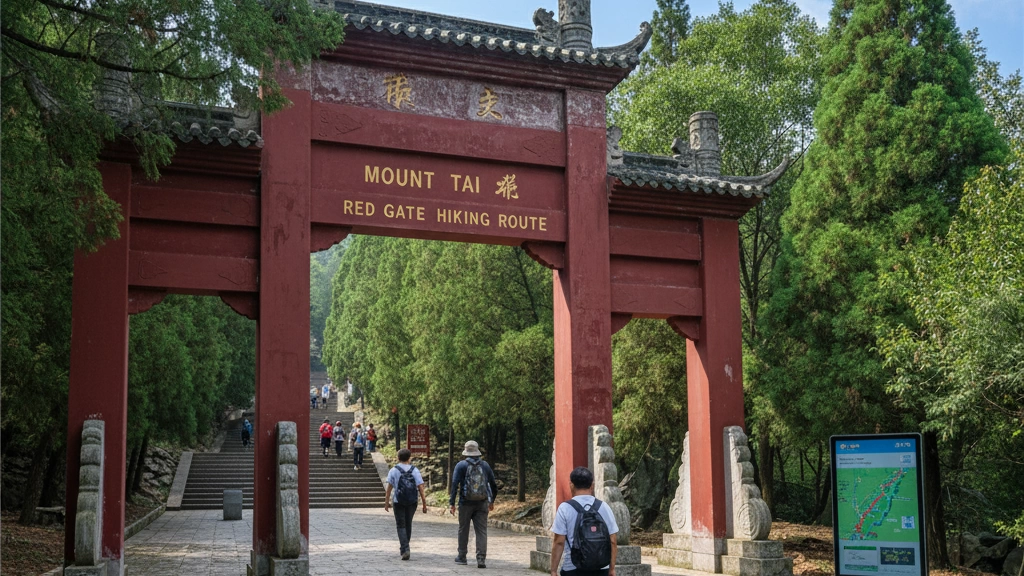
If you want the most “real” Mount Tai China experience, you hike the classic Red Gate route. This is the traditional pilgrimage climb and still the most meaningful way to reach the summit.
Where the Red Gate Route Starts in Tai’an
The Red Gate (Hongmen) trailhead sits on the north side of Tai’an city, at the base of Taishan Mountain (Taishan = Mount Tai).
- Start point: Red Gate (红门), in the urban area of Tai’an
- From Tai’an High-Speed Railway Station:
- Taxi: 20–30 minutes in normal traffic
- City bus: allow 40–50 minutes, very cheap but slower
- Tell the driver you’re going to “Taishan Hongmen” and they’ll know exactly where
If you want a detailed route breakdown before you go, I’d suggest checking a dedicated Mount Tai hiking route guide so you can match your fitness to the right starting point.
Distance, Elevation, and How Long the Red Gate Route Takes
This is a stair climb, not a casual walk. For most travelers from the U.S., it’s a serious workout.
- Total distance: ~9 km / 5.5 miles from Red Gate to Jade Emperor Peak
- Elevation gain: ~1,300–1,400 m (4,265–4,600 ft)
- Step count: ~6,000–7,500 steps depending on where you start counting
- Time for average visitor:
- Fast & fit: 3–4 hours up
- Average shape: 4–6 hours up
- With lots of breaks/photos: 6–7 hours up
Plan extra time if you’re:
- Not used to hills or stairs
- Traveling with kids or older parents
- Climbing in summer heat or on crowded holiday weekends
Famous Spots Along the Red Gate Route
One reason this route is so iconic is the number of historic and scenic spots along the way. You’re not just climbing; you’re walking through 2,000+ years of Chinese culture.
Key stops you’ll pass:
- Red Gate (Hongmen) – Traditional starting point with old stone arches and temples. Good place to stretch, buy water, and adjust your gear.
- Heavenly Candle Peak (Tianzhu Feng) – A distinct rock formation and photo spot with strong “classic China” mountain vibes.
- Mid-Heaven Gate (Zhongtianmen) – Roughly halfway up:
- Major rest zone, food stalls, small shops
- This is also where the Middle Heaven Gate cable car route reaches
- Eighteen Bends (Shiba Pan) – The most famous (and toughest) section:
- Very steep stone switchbacks
- Short distance but heavy leg burn
- Amazing sense of progress as you look back over the valley
- South Heaven Gate (Nantianmen) – You pass through here near the top onto the summit plateau
- Jade Emperor Peak (Yuhuang Ding) – The highest peak and main goal of most hikers, with temples and sweeping views
If you want to see what else you can combine with this classic climb, a broader Mount Tai overview is helpful when you’re building your trip.
Tips for Surviving the 6,000+ Steps
You don’t need to be an athlete, but you do need a plan. Here’s how I’d tackle it:
Pace and timing
- Start early: ideally between 5:00–7:00 a.m. to dodge midday heat and big crowds.
- Take short, frequent breaks instead of long sit-downs that cool your muscles too much.
- Set mini goals: Red Gate → Mid-Heaven Gate → Eighteen Bends → South Heaven Gate → Summit.
Gear and clothing
- Shoes: Broken-in walking or trail shoes with real grip. Do not climb in slick sneakers or fashion shoes.
- Socks: Good sports socks; avoid cotton if you blister easily.
- Layers: Lightweight, breathable top plus a light jacket/hoodie; it’s often cooler and windier near the top.
- Trekking pole (optional but smart): Saves your knees on the descent, especially if you skip the cable car down.
Hydration and energy
- Carry at least:
- 1–1.5 L of water per person in cool seasons
- 2 L+ in summer
- Pack simple snacks: nuts, trail mix, energy bars, or jerky. You’ll find food on the way, but it’s smart to have your own.
Health check
- If you have knee problems, heart issues, or haven’t exercised in years:
- Consider climbing partway and using the cable car
- Or take the bus/cable combo up and hike down only a section
Food, Water, and Rest Stops on the Red Gate Climb
You don’t need to haul everything from Tai’an, but don’t show up empty-handed either.
What’s available on the trail
- Small stalls and shops are scattered along the route:
- Bottled water and drinks
- Instant noodles, basic hot food
- Snacks (chips, sausages, simple Chinese street snacks)
- Prices go up the higher you climb, so it’s cheaper to buy near the bottom.
Where you can rest
- Red Gate: Benches, vendors, and space to adjust your pack, stretch, and prep.
- Mid-Heaven Gate (Zhongtianmen):
- Major rest and regroup area
- Public restrooms
- Food stalls and small restaurants
- Between Mid-Heaven Gate and South Heaven Gate:
- Multiple smaller rest spots with stone benches and viewpoints
- Great excuse to “stop for photos” when your legs are on fire
Practical money and comfort tips
- Bring some cash (RMB); a lot of small vendors may not accept foreign cards, and mobile pay apps like Alipay/WeChat Pay can be tricky for first-time U.S. visitors.
- Carry tissues/wet wipes; some bathrooms are basic.
- In summer, consider:
- Sunscreen
- Hat
- A small towel or cooling cloth
If you’re comfortable with a tough stair workout and can handle 4–6 hours of steady climbing, the Red Gate route is the most rewarding way to say you truly climbed Mount Tai.
Shuttle Bus and Middle Heaven Gate Cable Car Route (Mount Tai China)
If you want to experience Mount Tai (Taishan) without grinding through 6,000+ steps, this shuttle bus + Middle Heaven Gate cable car combo is the sweet spot. It’s the most popular “easy” Mount Tai China route for first-timers, families, and travelers on a tight schedule.
How to reach the Mount Tai tourist center and shuttle bus
You’ll first head to the official Mount Tai tourist center (usually called Tianwai Village / 天外村):
- From Tai’an High-Speed Railway Station (Tai’an East)
- Taxi: about 20–30 minutes in normal traffic.
- Ride-hail apps (DiDi) work well and are clearly priced.
- From Tai’an main/old station or city center
- Taxi: 10–20 minutes depending on where you stay.
- Ask your driver for “Taishan Tianwai Cun Tourists Center” (泰山天外村游客中心).
At the tourist center:
- Buy/scan your Mount Tai entrance ticket.
- Follow the signs for the official shuttle buses to Middle Heaven Gate (Zhongtianmen).
For a deeper logistics overview, I keep an updated breakdown of the main access points and transport options in my full Mount Tai China travel guide.
Shuttle bus ride to Middle Heaven Gate (Zhongtianmen)
Once you’re through the gate, you’ll board the scenic shuttle bus up the mountain road:
- Ride time: around 20–30 minutes depending on traffic.
- Road: paved, winding, with solid barriers and professional drivers.
- Views: pine forests, cliffs, and a preview of how high you’re going.
- Buses run frequently in the daytime; you rarely wait long in non-holiday periods.
You’ll get off at Middle Heaven Gate (Zhongtianmen / 中天门), which is the mid‑mountain transport hub and the base station for the main Mount Tai cable car.
Middle Heaven Gate cable car experience and views
From Zhongtianmen, follow the signs to the Middle Heaven Gate cable car:
- Ride time: about 10–15 minutes.
- Style: enclosed cabins, steady and beginner‑friendly.
- Views:
- Deep valleys and cliffs straight under your feet.
- Terraced temples and stone steps far below.
- On clear days, wide views over Tai’an city and the plains of Shandong.
- At the top station, you’re already close to the main summit area (near Jade Emperor Peak and major Mount Tai sunrise spots), so the remaining walk is much shorter and easier than the full climb.
If you like background and history while you ride, my Mount Tai history overview is useful context for the temples and tablets you’ll see at the top.
Time and cost vs full hiking Mount Tai
This route is a big time and energy saver compared with the full Red Gate hike.
Time comparison (rough ranges):
- Full Red Gate hike (up only):
- 3.5–6 hours depending on fitness and breaks.
- Shuttle bus + Middle Heaven Gate cable car (up only):
- Tourist center entry to summit: usually 60–90 minutes door to door.
- This includes buying tickets, bus ride, short waits, and cable car ride.
Cost comparison (estimate structure):
You’ll pay:
- Entrance ticket to Mount Tai.
- Shuttle bus fee (round trip or one way).
- Cable car ticket (up only, or round trip if you don’t want to walk down).
A full hiker only pays the entrance fee and maybe internal buses, but:
- You “pay” in time and leg power instead of cash.
- Most U.S. travelers I see are happy to spend more on the cable car to save their knees and squeeze more into a short China itinerary.
Who should choose this easier Mount Tai route?
This shuttle bus + Middle Heaven Gate cable car combo is ideal if:
- You want the Mount Tai summit views and temples, but not a brutal staircase workout.
- You’re on a day trip from Jinan, Qufu, or even Beijing/Shanghai and need to move fast.
- You’re traveling with:
- Kids
- Older parents
- Anyone with knee or back issues
- You’re going for the Mount Tai sunrise and want to keep energy for the early wake‑up.
- You prefer comfort and predictability over “I conquered every step.”
Who might skip it:
- Strong hikers who enjoy long climbs and want the full Red Gate experience.
- Budget travelers who want to avoid cable car costs and don’t mind 4–6 hours of stairs.
If you’re a typical U.S. traveler with limited vacation time, this route hits the right balance: you still feel like you’ve really been to Taishan Mountain China, but you don’t spend your entire day crawling up steps.
Peach Blossom Valley Route on Mount Tai China
If you want a quieter way up Mount Tai China (Taishan Mountain) with great views and less crowd stress, the Peach Blossom Valley route and new cable car on the western side is the move.
Where Peach Blossom Valley Entrance Is
The Peach Blossom Valley (Taohuayu) entrance sits on the western side of Mount Tai, a bit away from the classic Red Gate area.
- Nearest city: Tai’an, Shandong
- From Tai’an High-Speed Rail Station (Tai’an G站):
- Taxi: about 30–40 minutes in normal traffic
- Cost: usually around 60–90 RMB one way
- From old Tai’an city center / Dai Temple area:
- Taxi: about 20–30 minutes
- Look for signs for “桃花峪景区 / Peach Blossom Valley Scenic Area”
If you’re traveling from the US, this route is easy to reach by Didi (China’s Uber) or a hotel-arranged car. Just show the Chinese name on your phone.
Trail Conditions and Scenery (Western Side)
The Peach Blossom Valley trail feels more relaxed and natural than the classic stair route.
What to expect:
- Trail type:
- Paved paths + long stone steps, but generally less steep than the Red Gate section
- Still a real climb if you decide to hike, not a flat walk
- Scenery:
- Valleys, small waterfalls in season, streams, and forested slopes
- In spring, peach blossoms and fresh greenery
- In autumn, nice fall colors and clear air
- Crowds:
- Usually lighter than the main East Route
- Easier to get photos and quiet spots
For most US travelers, this western route feels more like a national park hike than a religious pilgrimage climb.
Peach Blossom Valley Cable Car: Details and Prices
The Peach Blossom Valley cable car is the newer cable car line on Mount Tai and one of the easiest ways to reach near the summit without hammering your knees.
Note: Prices change almost every year. Use these as 2024–early 2025 reference numbers and always double-check on Trip.com, official Mount Tai pages, or at the ticket window.
Typical setup:
- Cable car lower station: Inside the Peach Blossom Valley Scenic Area
- Upper station: Near the Mount Tai summit area, walking distance to Jade Emperor Peak and main viewpoints
- Ride time: ~8–15 minutes depending on cabin speed and loading
- Type: Enclosed cabins (good in wind, cold, or rain)
Approximate 2025 pricing (RMB) you’re likely to see:
| Item | Range (RMB) | Notes |
|---|---|---|
| Peach Blossom Valley entrance ticket | 30–60 | Sometimes bundled or seasonal |
| One-way cable car (Peach Blossom Valley) | 100–130 | Adult price |
| Round-trip cable car | 180–240 | Usually some discount vs two single rides |
| Shuttle/eco-bus inside the valley | 20–40 | If required during busy season |
Discounts:
- Kids, students, seniors (with valid ID) usually get reduced cable car and entrance prices
- Foreign students in US schools: sometimes accepted, sometimes not—always carry physical student ID and be ready to pay full price if they refuse
Pay with Alipay, WeChat Pay, or UnionPay card; cash is still accepted at most Mount Tai ticket windows.
Peach Blossom Valley vs Middle Heaven Gate Route
Both the Peach Blossom Valley route and Middle Heaven Gate (Zhongtianmen) cable car route are popular for visitors who don’t want to climb all 6,000+ steps. Here’s the real comparison:
Pros of Peach Blossom Valley:
- Fewer crowds than the classic Middle Heaven Gate route
- More natural scenery – valleys, streams, and seasonal flowers
- Newer cable car, usually smoother and more comfortable
- Starts lower on the west side, good if your hotel is closer there
Cons of Peach Blossom Valley:
- Slightly less “classic” – fewer traditional temples and historic spots compared with the main east route
- Transport from train stations is a bit less direct than going to the Red Gate / Tianwai Village side
- Fewer food and shop options compared to the busier East Route
Pros of Middle Heaven Gate Route:
- The most famous and traditional tourist route up Mount Tai
- Easy, well-signed from Tai’an and every Chinese travel platform
- More shops, food stands, and temples along the way
Cons of Middle Heaven Gate Route:
- Much more crowded, especially in peak seasons and weekends
- Longer lines for shuttle buses and cable cars
- Can feel more like a tourist conveyor belt than a peaceful hike
If you care more about comfort and nature than ticking off the classic route, Peach Blossom Valley wins.
Who Should Choose the Peach Blossom Valley Option
From a US traveler’s lens, I’d recommend Peach Blossom Valley + cable car for:
- Families with kids who don’t want a brutal staircase day
- Older travelers or anyone with knee issues
- Casual hikers who care more about scenery than tradition
- Travelers who hate crowds and want a calmer Mount Tai experience
- Short-trip travelers who want to save energy for Qufu, Jinan, or Qingdao later in their Shandong loop
You might want to skip Peach Blossom Valley if:
- You’re a serious hiker who wants the full historic Red Gate climb
- You’re chasing the classic “I climbed all the steps of Mount Tai” badge
- You’re super tight on time and just going with whatever route your tour guide or Chinese friend already knows (often Middle Heaven Gate)
For most US visitors planning 1–2 days around Mount Tai, the Peach Blossom Valley cable car route is a smart, comfortable, and less chaotic way to get a real taste of Mount Tai China without feeling wrecked the next day.
Watching the Mount Tai Sunrise in 2025
If you’re coming all the way from the US to visit Mount Tai China, catching sunrise from the summit is the one moment I tell people not to skip. It’s one of those “OK, the trip was worth it” experiences.
Why the Mount Tai sunrise is so famous
Mount Tai (Taishan Mountain China) has been a sacred site for emperors, poets, and philosophers for thousands of years, and sunrise is when it really feels like a “holy mountain.”
A few reasons it matters so much:
- Deep cultural weight – Ancient emperors held sunrise rituals here to “report” to heaven. Locals still see Mount Tai sunrise as a symbol of new beginnings and good luck.
- Classic quotes – Confucius supposedly said, “After climbing Mount Tai, the world looks small.” Watching sunrise makes that line feel very real.
- Atmosphere, not just views – You’re standing with hundreds of people in the dark, watching the sky go from black to deep blue to gold over Shandong. It’s quiet, excited, and very different from a normal scenic overlook.
Best sunrise viewing spots on Mount Tai summit
On the summit, these are the key Mount Tai sunrise viewpoints I recommend:
- Sun Viewing Peak (Riyuetan / Sunrise Viewing Peak) – Classic Mount Tai sunrise spot with a direct east-facing view. Best choice if you only pick one.
- Jade Emperor Peak (Yuhuangding) – Highest point on Mount Tai China. Great for wide views; can be busier but feels iconic.
- Near the main stone terraces – If the main platforms are jammed, step 50–100 feet back along the paths; you’ll still see the sun and have more space.
If you’re traveling with kids or parents, I’d stick to the main Sunrise Viewing Peak area. It’s more organized and easier to move around.
Typical sunrise times by season in 2025
Exact Mount Tai sunrise time 2025 will vary by day, but these are solid planning ranges (for the summit):
- Winter (Dec–Feb): around 7:00–7:20 a.m.
- Spring (Mar–May): around 5:30–6:00 a.m.
- Summer (Jun–Aug): around 4:45–5:20 a.m.
- Autumn (Sep–Nov): around 5:30–6:20 a.m.
Before your trip, I always:
- Check “Tai’an sunrise time” or “Mount Tai sunrise time 2025” on a weather app
- Add 30–45 minutes buffer so I’m on the platform before the sky actually starts changing
How to read the weather and cloud forecast
To decide if the Mount Tai sunrise will be worth the early wake-up, I look for:
- Cloud cover:
- Best: 20–60% cloud cover – enough clouds to catch color, but not block the sun
- Risky: Over 80% – likely gray-out; you might see light but not the sun disk
- Visibility / air quality:
- Look for “good” or “moderate” visibility and air quality; heavy haze can wash out the colors
- Wind and rain:
- Strong wind on the summit makes it feel much colder than Tai’an city
- If there’s rain or storms in the early morning, I skip and focus on daytime views
Download offline maps and a weather app before you leave the US, or make sure your China eSIM / SIM is set up so you can adjust last minute.
How early to claim a sunrise spot and avoid crowds
Mount Tai sunrise crowds are real, especially on weekends and Chinese holidays, but you can manage them:
- Normal weekdays (non-holiday):
- Aim to be at your chosen viewpoint at least 45–60 minutes before listed sunrise time
- Weekends and Chinese public holidays:
- Plan to arrive 60–90 minutes early; platforms can fill fast
- Practical tips:
- Bring a light jacket or down layer – summit wind before sunrise is cold, even in summer
- Pack a small headlamp or phone flashlight for dark paths
- Carry water and a snack; lines at summit shops get busy right after sunrise
- If you hate dense crowds, stand a bit off the main railings; you’ll still get the view without being shoulder-to-shoulder
For most US travelers, I recommend planning your Mount Tai China itinerary around one clear-weather sunrise window. When the sky cooperates, sunrise on Mount Tai is easily one of the best mountain moments in all of China.
Staying Overnight on the Summit of Mount Tai
If you’re coming from the US and want the classic Mount Tai China experience, I strongly recommend staying a night on the summit instead of trying to do everything in one crazy long day.
Why an Overnight Stay on Mount Tai Summit Is Worth It
Staying on top of Taishan Mountain makes the famous Mount Tai sunrise way less stressful:
- No 2–3 a.m. wake-up in Tai’an and mad rush up the stairs
- Time to rest, shower, eat, and explore the summit before sunrise
- You can check multiple viewpoints at sunset and sunrise, not just one
- If the weather is bad one morning, you still have evening and night views to enjoy
For most US travelers dealing with jet lag, an overnight on the summit is actually easier on the body than a brutal same-day climb.
Types of Summit Hotels and Guesthouses
Mount Tai summit hotels are simple and practical. Think mountain lodge, not luxury resort. Main types:
-
Basic summit hotels
- Older buildings, small rooms, limited amenities
- Usually have private bathrooms, but don’t expect Western 4-star standards
- Good enough if you just need a bed, heat, and hot water
-
Newer or “better” summit hotels
- Slightly larger rooms, more modern interiors
- Better heating and more consistent hot water
- Often closer to Jade Emperor Peak and main sunrise spots
-
Budget guesthouses / dorm-style rooms
- Shared rooms, thin walls, simple bedding
- Often noisy, but cheapest way to sleep on the summit
- Good if you’re a backpacker or student and care more about the experience than comfort
No matter which you pick, focus on location near main viewpoints and reliable heating—that matters more than décor.
Mount Tai Summit Hotel Prices in 2025 (Estimate)
Pricing on the summit varies a lot by season and demand. For 2025, here’s a realistic ballpark for US travelers:
- Low / shoulder season (rough idea)
Where to Stay for Mount Tai China – Tai’an City vs Mount Tai Summit
When you plan a Mount Tai China trip, your biggest stay question is simple: sleep in Tai’an city or pay more to stay on the Mount Tai summit. I’ll break it down like I would if you were a friend flying in from the U.S. and wanted a clean, efficient setup.
Stay in Tai’an City – Pros and Cons
Why I like staying in Tai’an city
Staying in Tai’an works well if you want comfort, better value, and easy transport.
Pros of staying in Tai’an city:
- Better hotels for the price
- Nicer rooms, more space, better bathrooms than most summit options
- Western-style beds and more reliable heating/AC
- Easy access to trains and buses
- Fast to reach from the Tai’an high-speed rail station
- Simple to grab a taxi or Didi to the Mount Tai (Taishan) tourist center or Red Gate
- More food choices
- Real local restaurants, street food, plus some Western options
- Easier to find coffee, snacks, and late-night food
- Good for families and first-timers
- More comfortable if you’re traveling with kids or older parents
- Easier to regroup after a long day on the mountain
Cons of staying in Tai’an city:
- You’ll miss the “sleep on the sacred mountain” experience
- You need to manage transport timing
- Early start if you want to catch sunrise using cable cars
- No late-night mountain atmosphere
- Once you come down, the spiritual feel of Mount Tai is gone for the day
If you’re used to U.S. hotel standards and want a simple, smooth Mount Tai China travel plan, Tai’an city is usually the smart base.
Best Areas to Stay in Tai’an Near Mount Tai
For a clean, simple layout, here are the main areas I recommend:
1. Near the Mount Tai Scenic Area South Gate / Red Gate
Best if your focus is purely how to climb Mount Tai.
- Why stay here
- Short taxi or even walk to the Red Gate trailhead
- Easy access to shuttle buses and ticket offices
- Good for
- Hikers starting early
- Travelers doing a same-day Mount Tai hike
2. Around Tai’an High-Speed Train Station (Tai’an Station)
Best if you’re doing a Mount Tai day trip from Jinan, Beijing, or Shanghai by bullet train.
- Why stay here
- Super convenient for early or late trains
- Easy to grab a taxi to Mount Tai (about 20–30 minutes)
- Good for
- Tight schedules
- Business travelers adding Mount Tai to a China itinerary
3. Old City / Dai Temple Area
Best if you want some history around your Mount Tai trip.
- Why stay here
- Close to Dai Temple, the historic gateway to Mount Tai
- Walkable streets, local restaurants, and more “old China” vibe
- Good for
- Culture lovers
- Anyone who wants to mix hiking and sightseeing
Recommended Luxury and Boutique Hotels in Tai’an
If you want something closer to U.S. comfort levels, these are the types of places I’d look for around Mount Tai:
- International or high-end local brands near the mountain
- Look for five-star hotels around the South Gate / scenic area
- Expect: larger rooms, strong heating/AC, decent English at front desk
- Boutique hotels near Dai Temple or the old town
- Smaller design properties with a more local feel
- Good for couples or travelers who want atmosphere over a big chain vibe
- Upscale hotels near the high-speed rail station
- Business-style, modern, efficient
- Perfect if you’re juggling meetings and a Mount Tai hike
What I focus on when picking luxury/boutique near Mount Tai:
- Walkable or short taxi to the Mount Tai entrance
- Solid reviews on cleanliness and noise
- Breakfast included so you can just fuel up and go
- 24-hour front desk for early departures or late arrivals
Good Budget and Mid-Range Hotels for Mount Tai Travelers
If you’re okay trading some polish for price, Tai’an is friendly to budget travelers from the U.S.
What to expect from budget/mid-range hotels:
- Clean but basic rooms
- Simple Chinese-style breakfast or none
- Limited English spoken, but translation apps work fine
Where to book budget or mid-range in Tai’an:
- Near South Gate / Red Gate – ideal for hikers; lots of guesthouses and value hotels
- Near Tai’an Station – chain budget hotels that are predictable and practical
- Near Dai Temple – guesthouses with more local character
Things I always check before booking:
- Recent reviews on cleanliness
- Photos of bathrooms and beds
- Distance to the Mount Tai entrance or bus stop
- Heating in winter and AC in summer (Mount Tai weather can swing hard by season)
When It Makes Sense to Pay Extra for a Mount Tai Summit Hotel
Staying on the Mount Tai summit isn’t about comfort; it’s about experience and convenience.
You should consider a summit hotel if:
- You’re serious about seeing the Mount Tai sunrise
- Waking up on the summit means no 2–3 am climb or rush from Tai’an
- You can just roll out, walk a few minutes, and get a prime sunrise spot
- You want that “I slept on a sacred mountain” moment
- Mount Tai is huge in Chinese culture; staying on top adds to the story
- You’re traveling slow and want a less rushed trip
- Hike up one day, sleep on top, explore sunrise, and then come down at your own pace
- You’re okay with paying more for less comfort
- Rooms on the summit are often:
- Smaller
- More expensive
- Older and noisier
- But you’re buying location, not luxury
- Rooms on the summit are often:
You may NOT need a summit hotel if:
- You’re fine taking the cable car and shuttle buses for sunrise (but you’ll start very early)
- You prefer guaranteed comfort, quieter nights, and better value in Tai’an city
- You have kids or older parents who need a more stable, quiet environment
Quick – How I Decide Where to Stay for Mount Tai China
If I’m planning for travelers from the U.S., here’s how I usually frame it:
-
First visit, limited time, want comfort?
→ Stay in Tai’an city, near the South Gate or Dai Temple. -
You want the iconic Mount Tai sunrise and don’t mind basic rooms?
→ Pay extra for one night on the Mount Tai summit. -
You’re doing a fast in-and-out with bullet trains?
→ Base near Tai’an high-speed rail station, then taxi to the mountain.
Pick your stay based on how much you care about sunrise convenience vs. comfort vs. budget. Once you know that, Tai’an city vs Mount Tai summit becomes an easy call.
One-Day Mount Tai Itinerary Options
If you only have one day for Mount Tai (Taishan), you can still see the best views without feeling wrecked. Here’s how I’d plan it for most U.S. travelers who want a solid experience but don’t want a death march.
Mount Tai Day Trip from Jinan or Tai’an
From Jinan (bullet train + buses/cable car)
What most people do from Jinan:
| Step | Time (approx.) | What to Do |
|---|---|---|
| 1 | 6:30–7:30 a.m. | Bullet train Jinan → Tai’an (20–40 min, high-speed) |
| 2 | 7:45–8:15 a.m. | Taxi/DiDi to Mount Tai Tourist Center (Hongmen or Tianwai Village) |
| 3 | 8:30–9:00 a.m. | Buy Mount Tai ticket + shuttle bus package |
| 4 | 9:00–9:30 a.m. | Shuttle bus to Middle Heaven Gate (Zhongtianmen) |
| 5 | 9:30–10:00 a.m. | Cable car up to near summit |
| 6 | 10:00 a.m.–1:00 p.m. | Walk summit area, Jade Emperor Peak, main Mount Tai viewpoints |
| 7 | 1:00–2:00 p.m. | Lunch on the mountain |
| 8 | 2:00–3:30 p.m. | Walk more viewpoints or cable car down |
| 9 | 3:30–4:00 p.m. | Shuttle bus back to Tourist Center |
| 10 | 4:00–4:30 p.m. | Taxi back to Tai’an train station |
| 11 | 5:00–7:00 p.m. | Bullet train Tai’an → Jinan / Beijing / Shanghai |
This works well if you’re based in Jinan and just want the Mount Tai cable car experience plus summit views.
From Tai’an (easier for a same-day Mount Tai trip)
If you’re already staying in Tai’an city, it’s even simpler:
- Morning:
- Taxi/DiDi to Red Gate (Hongmen) or Tianwai Village Tourist Center
- Buy Mount Tai entrance ticket + shuttle bus
- Evening:
- Return by taxi to your Tai’an hotel or directly to the train station for a late train out
For most U.S. visitors, I’d stay one night in Tai’an if you can. It gives you more margin for delays and lets you slow down a bit.
Sample One-Day Mount Tai Itinerary (Cable Car + Shuttle Bus)
If you want views, temples, and photos without burning your legs, this is the most realistic one-day Mount Tai China travel guide plan.
“Easy Mode” Itinerary (summit with help)
Ideal for: average fitness, families, first-timers, people on a China rail itinerary.
Plan:
- 7:30–8:30 a.m. – Breakfast + head to Tianwai Village Tourist Center
- 8:30–9:00 a.m. – Buy Mount Tai entrance ticket + shuttle bus + Middle Heaven Gate cable car
- 9:00–9:30 a.m. – Shuttle bus to Middle Heaven Gate (Zhongtianmen)
- 9:30–10:00 a.m. – Cable car to South Heaven Gate near the summit
- 10:00 a.m.–1:00 p.m. – Walk the summit area:
- Jade Emperor Peak (Yuhuangding)
- Sun Viewing Peak
- Main temples and stone inscriptions
- 1:00–2:00 p.m. – Lunch at a simple summit restaurant (nothing fancy, but convenient)
- 2:00–3:00 p.m. – Extra viewpoints or slow walk, photos, Mount Tai sunrise spots (for scouting if you ever return overnight)
- 3:00–3:30 p.m. – Cable car down to Middle Heaven Gate
- 3:30–4:00 p.m. – Shuttle bus back to Tourist Center
- 4:00 p.m. onward – Taxi to Tai’an station or your hotel
This gives a full Mount Tai experience in 6–8 hours on the mountain with low stress.
Same-Day Mount Tai Hike + Return Train Timing
If you want to actually hike Mount Tai (Red Gate route) and still catch a return train the same day, you need to be organized.
Basic timing math
- Red Gate → Summit (full hike):
- 4–6 hours for fit hikers
- 6–8 hours for average walkers
- Summit → Middle Heaven Gate by stairs: 2–3 hours down
- Middle Heaven Gate → Tourist Center (bus): 30 minutes
- Transfers (taxis, tickets, security, etc.): add 1–1.5 hours buffer
To keep a same-day plan realistic:
- Arrive at Mount Tai ticket area no later than 8:00 a.m.
- Book your return train after 7:00 p.m. if you do a full hike up
- Or hike up and take the cable car down to save time and knees
How Fit You Should Be for a One-Day Mount Tai Climb
For U.S. travelers used to normal city walking but not serious hiking, here’s the honest breakdown.
Full Red Gate hike (up only) same day:
- Required fitness:
- Comfortable walking 6–8 miles in a day
- OK with 6,000+ steep stone steps
- No major knee, ankle, or heart issues
- Expect:
- Sweating hard, especially in summer
- Sore calves the next day
- Need for multiple short breaks and plenty of water
Cable car + short walking option:
- Required fitness:
- Able to walk 2–4 miles total with some uphill and stairs
- Fine at elevation (but Mount Tai isn’t super high, so altitude sickness is rare)
- Great for:
- Families with kids
- Travelers in China on business who want to squeeze in a quick Taishan Mountain China visit
- Anyone who doesn’t want to blow out their legs mid-trip
If you’re unsure, cable up, walk a bit, cable down. You still get the Sacred Mountain experience.
Tips to Avoid Rushing and Missing Key Mount Tai Sights
You only have one day, so it’s about smart choices, not doing everything.
1. Lock your priorities
Decide your must-dos before you go:
- Views + easy walking?
→ Shuttle bus + cable car + summit loop - Proud “I climbed Mount Tai” moment?
→ Start at Red Gate, hike at least to Middle Heaven Gate, then consider cable up - Photos of temples and culture?
→ Focus more time on Jade Emperor Peak, Sun Viewing Peak, main temples
2. Book trains with a buffer
- Leave at least 1.5–2 hours between “back at Tourist Center” and “train departure”
- On busy weekends/holidays, add another 30–60 minutes for lines
3. Use taxis/DiDi, not local buses
- For a one-day Mount Tai itinerary, local buses will slow you down
- Taxis/DiDi are cheap by U.S. standards and save a ton of time
4. Don’t overschedule
Skip trying to do Mount Tai + Dai Temple + Qufu/Jinan all in one day. With just one day, focus on:
- Half day summit + half day relaxed visit in Tai’an, or
- Full day on the mountain, then late train out
5. Bring the right basics
To keep moving and avoid wasting time:
- Cash/WeChat/Alipay for quick food and tickets
- Snacks (energy bars, nuts, jerky) so you’re not stuck hunting for food
- Refillable bottle – you can buy drinks on the way, but prices climb with altitude
- Offline map or screenshots of routes and names (Zhongtianmen, Tianwai Village, Hongmen, etc.)
Plan it right, and a one-day Mount Tai China travel guide style trip from Jinan or Tai’an is totally doable, memorable, and doesn’t wreck the rest of your China itinerary.
Two-Day Mount Tai and Shandong Itineraries (Perfect for US Travelers)
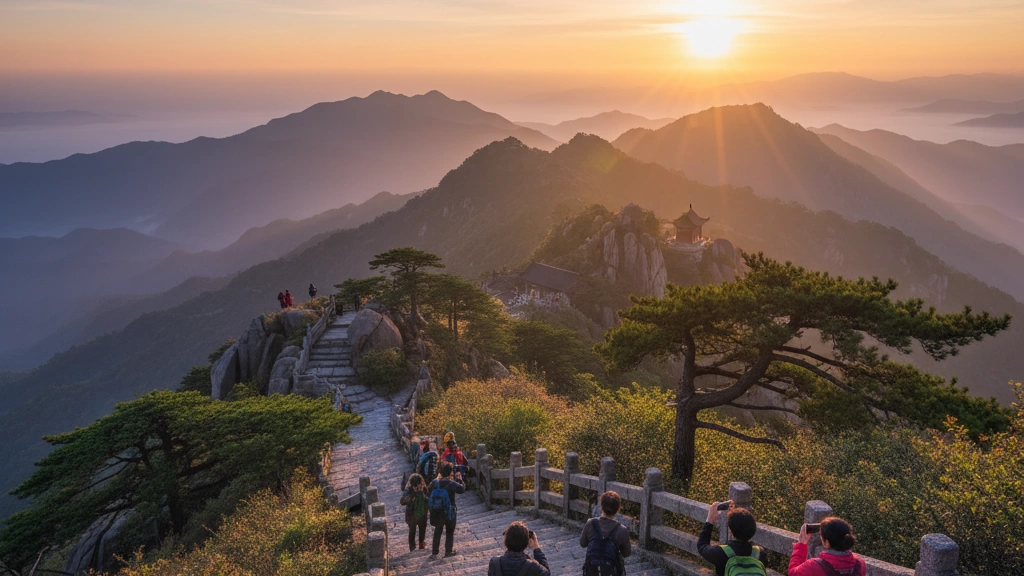
If you’ve got 2 days in Shandong, you can do a lot more than just “climb and go.” Here’s how I’d plan a smart, low-stress 2-day Mount Tai China trip that works for most US travelers, with clear options for families and slower travelers.
Relaxed 2-Day Mount Tai Plan With Summit Sunrise
Goal: One climb, one sunrise, no rushing for trains.
Day 1 – Arrive, Climb, Sleep on the Summit
-
Morning
- Arrive in Tai’an by high-speed train (from Jinan, Beijing, or Shanghai).
- Drop luggage at a hotel near the Mount Tai entrance or leave at the station’s left-luggage.
- Early lunch near the mountain (simple noodles, dumplings, fried rice).
-
Afternoon
- Head to the Mount Tai tourist center.
- Take the shuttle bus to Zhongtianmen (Middle Heaven Gate).
- Either:
- Take the Middle Heaven Gate cable car up and walk the last section to Jade Emperor Peak, or
- Hike the upper section if you want a taste of the stairs without doing the full Red Gate route.
- Check into a Mount Tai summit hotel (basic but convenient).
-
Evening
- Walk between Jade Emperor Peak and Sun Viewing Peak.
- Early dinner on the summit (simple Chinese dishes; prices are higher than in town).
- Go to bed early – sunrise is your main event.
Day 2 – Sunrise, Descent, Dai Temple, Old Tai’an
-
Very Early Morning
- Check Mount Tai weather and clouds the night before.
- Get to your sunrise spot 30–45 minutes before sunrise.
- Best spots:
- Sun Viewing Peak
- Platforms near Jade Emperor Peak
-
Morning
- After sunrise, grab breakfast on the summit.
- Take the cable car + shuttle bus back down.
- Return to your hotel in Tai’an to shower and repack.
-
Afternoon
- Visit Dai Temple at the foot of Mount Tai (key UNESCO-related site; this is where emperors worshiped before their Mount Tai ceremonies).
- Stroll old Tai’an streets near Dai Temple – good for snacks, tea, and souvenir shopping.
- Evening: head out by train to Jinan, Qufu, or back toward Beijing/Shanghai.
This 2-day Mount Tai travel guide plan gives you:
- Summit sunrise
- Zero late-night climbs
- Time for culture (Dai Temple + old Tai’an)
Suggested Timing for Dai Temple and Old Tai’an
Here’s how I’d time Dai Temple and the old city around your Mount Tai hike:
- Best time for Dai Temple:
- Day 2 late morning or early afternoon after you come down from the mountain.
- Plan 1.5–2 hours for the temple complex.
- Old Tai’an walking time:
- Add 1–2 hours to wander the nearby streets:
- Small snack shops
- Local restaurants
- Tea houses and small markets
- Add 1–2 hours to wander the nearby streets:
Quick tips:
- Buy a combo ticket if offered (Dai Temple + Mount Tai) to save a bit.
- Wear comfortable shoes – lots of stone paving and courtyards.
Adding Qufu (Confucius Temple and Cemetery)
If you want culture with your climb, Qufu is the move.
- Why add Qufu to your Shandong Mount Tai trip:
- It’s the hometown of Confucius.
- The Confucius Temple, Confucius Mansion, and Confucius Cemetery are all major cultural sites.
- Travel time:
- High-speed train Tai’an ⇄ Qufu East: about 30–40 minutes.
2-Day Mount Tai + Qufu Example
-
Day 1 – Mount Tai
- Morning: Arrive Tai’an, go straight to the mountain.
- Afternoon: Cable car up, summit walk, check into summit hotel.
- Evening: Early sleep, prep for sunrise.
-
Day 2 – Sunrise + Qufu
- Early: Sunrise on Mount Tai, descent via cable car + shuttle bus.
- Late Morning: Train Tai’an → Qufu East.
- Afternoon: Visit Confucius Temple and Mansion in Qufu’s old town.
- If you’re not rushed, you can add the Confucius Cemetery or stay overnight in Qufu.
This combo hits Nature + Sunrise + Confucian culture in 2 days, which works well for US travelers who want more than just views.
Combining Mount Tai With Jinan “City of Springs”
If you like cities with character, add Jinan to your Mount Tai China travel guide plan.
- Why Jinan:
- Famous for its artesian springs.
- Easy high-speed train hop from Tai’an (20–30 minutes).
Key Jinan spots:
- Baotu Spring Park
- Daming Lake
- Old commercial streets and local snack streets
2-Day Mount Tai + Jinan Example
-
Day 1 – Jinan
- Morning: Arrive Jinan.
- Afternoon: Visit Baotu Spring and Daming Lake.
- Evening: Street food and local beer; overnight in Jinan.
-
Day 2 – Mount Tai Day Trip
- Early Morning: Bullet train Jinan → Tai’an.
- Take shuttle + cable car to the summit for daytime views (or partial hike).
- Late Afternoon/Early Evening: Return to Tai’an station, bullet train back to Jinan or onward to Beijing/Shanghai.
This works well if you:
- Don’t care about sunrise
- Prefer a city base with more hotel and restaurant choices
Sample Schedules for Families and Slower Travelers
If you’re traveling with kids, parents, or you just prefer a slower style, here are setups that work.
Option 1 – Family-Friendly 2-Day Mount Tai (Cable Car Focus)
Day 1 – Tai’an + Dai Temple
- Morning: Arrive in Tai’an, check into a hotel near the mountain.
- Late Morning: Visit Dai Temple (kids can roam the courtyards).
- Afternoon: Explore old Tai’an and shop for snacks and drinks for the hike.
- Evening: Early dinner, early sleep.
Day 2 – Mount Tai Summit (Easy Version)
- Morning:
- Take the shuttle bus + Middle Heaven Gate cable car up.
- Walk the summit area at your own pace (Jade Emperor Peak, Sun Viewing Peak).
- Afternoon:
- Take cable car + bus down.
- Head on to Jinan or back to your next city.
Why this works for families:
- No night hiking.
- Limited stairs.
- Flexible schedule if kids get tired.
Option 2 – Slower Travelers With Sunrise, No Rushing
Day 1 – Light Climb + Summit Stay
- Late Morning: Arrive Tai’an, leave big luggage at hotel or station.
- Afternoon:
- Shuttle bus → cable car → summit.
- Easy stroll between main viewpoints.
- Evening: Dinner on the summit, early night.
Day 2 – Sunrise + Cultural Stop
- Very Early: Sunrise viewing.
- Morning: Descent via cable car + shuttle.
- Late Morning/Afternoon:
- Visit Dai Temple or
- Take the train to Qufu or Jinan for a half-day city visit.
Quick Planning Tips for US Travelers
- Use bullet trains: Plan your base around Tai’an, Jinan, or Qufu using high-speed trains – they’re clean, fast, and easy to book on Trip.com or the 12306 app.
- Don’t overpack the schedule: Two major activities per day is enough:
- Example: Morning climb + afternoon temple, or sunrise + Qufu.
- Leave buffer time: China’s train stations are big. Get there at least 40–60 minutes early, especially with kids or luggage.
- Think in combos:
- Mount Tai + Qufu = Nature + Confucius
- Mount Tai + Jinan = Mountain + City of Springs
- Mount Tai + Dai Temple + Old Tai’an = Classic Shandong culture
These 2-day Mount Tai and Shandong itineraries keep your trip realistic, flexible, and smooth while still hitting the big highlights – sunrise on Taishan Mountain, key cultural sites, and an easy flow between cities.
What to Eat in Tai’an and on Mount Tai
Must-try local dishes around Mount Tai China
When I plan a Mount Tai trip, I always leave real time for eating in Tai’an. The food is simple, filling, and made for hikers.
Local dishes to look for:
-
Taishan Pancake (泰山煎饼 / Taishan Jianbing)
Super thin grain pancake, often rolled with egg, scallions, chili sauce, and crispy fried dough. Great pre‑ or post‑hike carb bomb. -
Taishan Tofu Banquet (泰山豆腐宴)
Different tofu dishes in one meal: braised tofu, fried tofu cubes, tofu skins. Light but high protein, good if you’re walking all day. -
Braised Yellow River Carp (黄河鲤鱼)
Local river fish, usually sweet‑savory with a rich sauce. Order this if you want a more “dinner with dishes” style meal. -
Stewed Chicken with Mushrooms (小鸡炖蘑菇)
Hearty, very home‑style. Goes perfectly with rice after a long day on the mountain. -
Taishan Peanut and Walnut Snacks
Roasted peanuts, nougat‑style walnut candy, and sesame treats. Easy to pack as hike snacks.
If you’re used to U.S. portions, you’ll feel right at home: dishes are generous and meant to share.
Where to eat near Tai’an train station and old city
Most U.S. travelers hit Tai’an High-Speed Railway Station (Taian East) or Tai’an Station then head straight to the mountain. I’d do a quick meal either at the station area or in the old city.
Near Tai’an High-Speed Railway Station (Taian East):
-
Fast casual Chinese chains (e.g., Lanzhou noodle shops, claypot rice, dumpling spots)
- Good for 20–30 minute meals between trains and hotel check‑in.
- Easy to order with pictures/menu boards.
-
Local noodle and dumpling joints
- Hand-pulled noodles, wontons, fried rice, simple stir‑fries.
- Great if you want cheap, filling comfort food before the climb.
Near the old city / Dai Temple area:
This is where I’d base myself if I want real local flavor.
-
Family-run Shandong restaurants
- Order Taishan tofu dishes, stewed meats, seasonal veggies.
- Ask for “少油少盐” (less oil, less salt) if you like lighter flavors.
-
Street snacks at night
- Grilled skewers, jianbing, steamed buns, cold noodles in summer.
- Best place to load up on snacks for the next morning.
Tip:
If you’re staying near the mountain’s main gate or Dai Temple, check hotel staff for 1–2 go‑to local spots. They usually know which places are honest on price and safe for Western stomachs.
Food options on Mount Tai during your climb
You won’t go hungry on Mount Tai (Taishan Mountain China), but food gets more expensive the higher you go.
On the mountain you’ll find:
-
Small kiosks and stalls every 15–30 minutes of walking:
- Bottled water, tea, sports drinks
- Instant noodles, sausages, hard‑boiled eggs
- Cucumber, tomatoes, corn on the cob
- Simple snacks: nuts, cookies, chocolate
-
Restaurants/food courts at key spots:
- Mid-Heaven Gate (Zhongtianmen / Middle Heaven Gate)
- South Heaven Gate / near Jade Emperor Peak
- They sell hot noodles, fried rice, basic stir‑fried dishes, and boxed meals.
My usual strategy:
- Buy most snacks and water in Tai’an city (cheaper, more variety).
- Top up drinks and maybe one hot meal on the mountain for the experience and convenience.
- Don’t rely on card-only — many small stalls still prefer mobile pay or cash.
Vegetarian and halal food near Mount Tai
You can eat pretty clean and still enjoy local classics around Mount Tai China.
Vegetarian options:
- Tofu banquet restaurants – easy to build a full vegetarian meal.
- Common veggie dishes you can order:
- Stir‑fried green beans
- Egg and tomato
- Stir‑fried seasonal greens
- Cold cucumber salad
- Spicy shredded potatoes
- Say “我吃素,不要肉” (I’m vegetarian, no meat) and also mention “不要肉汤” (no meat broth) if that matters to you.
On the mountain for vegetarians:
- Steamed buns (plain or veggie)
- Corn, potatoes, simple noodles with veggies
- Pack nuts, protein bars, and dried fruit from home or from a supermarket in Tai’an for backup.
Halal options:
- Around Tai’an city, look for:
- Lanzhou beef noodle shops (often halal)
- Restaurants with “清真” (halal) signs at the door
- Dishes: beef noodles, lamb skewers, stir‑fried veggies, fried rice with no pork.
On the mountain itself, halal is harder to guarantee. If this matters to you:
- Eat a solid halal meal in the city before and after the climb.
- Bring your own snacks for the mountain.
Average food prices and how much cash to bring
Prices change, but for 2025 Mount Tai travel, this is a good working range for U.S. travelers:
In Tai’an city:
- Street snack / quick breakfast: ¥8–20 (about $1–3).
- Simple noodle or dumpling meal: ¥20–40 ($3–6).
- Sit‑down restaurant (2 people, 3–4 dishes + rice): ¥80–160 ($11–23).
- Coffee chains / milk tea: ¥15–35 ($2–5).
On Mount Tai:
- Bottled water: ¥5–10 ($1–1.50).
- Instant noodles / basic snack: ¥10–25 ($1.50–4).
- Simple hot meal set: ¥40–80 ($6–11).
- Summit restaurants and hotels: expect city price × 1.5–2.
How much cash to bring for food:
- Day trip from Tai’an:
- Budget ¥150–250 per person ($20–35) for food and drinks if you’re not going fancy.
- Including extra coffee, desserts, and late‑night snacks:
- Plan ¥250–350 per person ($35–50).
Most big places accept bank cards and mobile pay, but as a U.S. traveler, you’ll want:
- ¥200–300 in cash per person for mountain stalls, small shops, and as backup if your card or app doesn’t work.
- Your main spend (trains, hotels, bigger restaurants) can run through card or mobile payments if you’ve set them up.
If you treat food like part of the adventure instead of a quick box to tick, Mount Tai and Tai’an will deliver solid, no‑nonsense meals that actually fuel the climb.
Essential Packing List for Climbing Mount Tai China
If you’re coming from the U.S. to climb Mount Tai, pack for stairs, changing weather, and crowds. Here’s exactly what I’d bring and what I recommend to all Mount Tai China travelers.
Clothing Layers for Mount Tai Seasons
Mount Tai weather changes fast, especially if you’re chasing sunrise or staying overnight. Think light, layerable, quick-dry.
Spring (Mar–May) / Fall (Sep–Nov)
- Base layer:
- Moisture-wicking T-shirt or long-sleeve (no heavy cotton)
- Mid layer:
- Thin fleece or lightweight sweatshirt
- Outer layer:
- Packable windbreaker or light rain jacket
- Extras:
- Light beanie + thin gloves for sunrise
- Lightweight hiking pants or leggings
Summer (Jun–Aug)
- Top:
- Quick-dry T-shirt or athletic tank
- Bottom:
- Breathable hiking shorts or light pants
- Sun protection:
- Cap or brimmed hat
- Sunglasses (UV protection)
- High SPF sunscreen (and lip balm with SPF)
- Rain:
- Compact poncho or ultralight rain jacket (summer storms hit fast)
Winter (Dec–Feb)
- Base:
- Thermal top and bottom
- Mid:
- Fleece or light down jacket
- Outer:
- Windproof, water-resistant shell
- Cold-weather extras:
- Warm hat, insulated gloves, neck gaiter
- Thick socks, maybe foot warmers for sunrise
Footwear, Socks & Gear for 6,000+ Steps
The Mount Tai China stairs are stone, steep, and endless. Comfort and grip matter more than style.
Footwear
- Trail runners or light hiking shoes with:
- Good grip on stone steps
- Decent cushioning
- Already broken in (don’t test new shoes here)
- Avoid: flat sneakers with slick soles, heavy boots, or anything you wouldn’t walk a half marathon in.
Socks
- Moisture-wicking hiking socks (merino or synthetic)
- Bring 1 extra pair in your daypack (change if your feet get sweaty or wet)
Basic hiking gear
- Small daypack (15–25L) with chest strap
- Lightweight trekking poles (optional but great for knees on the descent)
- Compact towel or bandana for sweat
- Refillable water bottle (1–1.5L) or soft flask
- Snacks: nuts, jerky, trail mix, granola bars, electrolyte packets
Tech Essentials for Mount Tai China
China’s Great Firewall + long days outdoors means you want the right tech setup.
Power & connectivity
- Power bank (10,000–20,000 mAh) – your phone will drain from photos, maps, and low temps at the summit
- Charging cable + wall adapter (China uses Type A/C plugs; U.S. Type A works in many spots, but bring a universal adapter to be safe)
- eSIM or SIM card for China data:
- eSIM from providers like Airalo/Holafly (easiest for U.S. travelers)
- Or physical China SIM (you’ll need passport to buy locally)
Apps & offline tools
- Offline maps (download Mount Tai & Tai’an area on Google Maps if you use a VPN, or use Maps.me / Apple Maps offline)
- Translate app with offline Chinese (Simplified) pack
- VPN installed before you leave the U.S. if you want Google, Gmail, Instagram, etc. (Nord, Express, etc.)
- Optional but helpful:
- Notes app with hotel info, addresses in Chinese, and reservation screenshots
- Weather app to check Mount Tai sunrise conditions
Documents, Cash & Ticket Backups
PRactical, especially if you’re hopping trains and using QR codes everywhere.
Must-carry documents
- Passport (you’ll need it for trains, hotels, and sometimes ticket checks)
- China visa details (if sticker, it’s already in passport; if digital, keep a print or screenshot)
- Digital + printed copies of:
- Passport photo page
- Main bookings (trains, hotels, Mount Tai entrance, if prepaid)
Money & payments
- Physical cash (RMB) – Mount Tai kiosks and small shops may be cash-only or local-pay only:
- I’d carry 300–500 RMB in small bills for food, water, and emergencies
- Credit/debit cards – Visa/Mastercard for hotels and bigger restaurants in Tai’an
- If you’re comfortable:
- Set up WeChat Pay or Alipay for foreigners (linked to U.S. card) before you travel. It makes transport and food much easier.
Ticket & travel backups
- Screenshots of:
- Mount Tai entrance tickets or barcodes (if booked via Trip.com)
- Train tickets and seat info
- Hotel name & address in Chinese + English
Optional Items That Make the Mount Tai Climb Easier
Not all of this is mandatory, but as a U.S. traveler you’ll probably be glad you brought at least a few of these.
- Compact headlamp or small flashlight
- Essential if you climb before dawn for the Mount Tai sunrise or walk downhill after dark
- Lightweight foldable down jacket
- Packs tiny, perfect for chilly summit wind, especially in spring/fall
- Face mask or buff
- Helpful for crowds, dust, or cold air at the summit
- Mini first-aid kit
- Blister plasters (e.g., Compeed), band-aids, pain reliever, any personal meds
- Electrolyte tablets or packets
- Good in summer heat or if you sweat a lot
- Anti-chafe balm
- For inner thighs, feet, or anywhere that rubs during thousands of steps
- Hand sanitizer + tissues/wet wipes
- Some bathrooms won’t have toilet paper or soap
- Small foldable tote or packable bag
- For extra layers, snacks, or souvenirs when you don’t want to reorganize everything
- Compact umbrella
- Double-use: rain and sun shade, especially in summer
Quick Packing for U.S. Travelers
If you want a fast checklist for Mount Tai China:
- Wear: broken-in trail shoes, hiking socks, breathable shirt, light pants/shorts, sun hat
- Pack:
- Layers: thin fleece, wind/rain jacket
- Tech: phone, power bank, VPN, eSIM/SIM, offline maps
- Admin: passport, cash (300–500 RMB), ticket screenshots
- Comfort: water, snacks, wipes, basic meds, optional trekking poles
Pack light but smart, and Mount Tai feels a lot more like an amazing climb and a lot less like a struggle.
Safety, Health and Crowd Tips on Mount Tai China
Physical fitness and altitude on Mount Tai
Mount Tai (Taishan Mountain) is not extreme, but it’s a real workout. I treat it like a serious day hike, not a walk in the park.
-
Know your baseline
- If you can comfortably climb 10–20 flights of stairs at home, you can handle the easier Mount Tai hiking routes with breaks.
- If you have heart, lung, knee, or blood pressure issues, talk to your doctor before you plan how to climb Mount Tai.
-
Altitude facts
- Summit height is about 5,000 ft (1,545 m), so classic high-altitude sickness is uncommon.
- Most people feel fatigue, not “altitude sickness.” Pace yourself and don’t try to race local hikers.
-
Pacing strategy
- Break the climb into short pushes + real rests (sit down, drop your backpack, drink water).
- Use the shuttle bus and cable car if you’re not used to long stair climbs; you’ll still get the Mount Tai China experience without burning out.
-
Hydration and energy
- Carry a refillable bottle and small snacks (nuts, energy bars, fruit).
- Avoid trying to “tough it out” without water just to move faster. Dehydration hits harder when you’re climbing thousands of steps.
Staying safe on steep stairs and in wet weather
Most Mount Tai safety issues come from slippery steps and crowd pressure, not wild terrain.
-
Footwear first
- Wear broken‑in sneakers or light hiking shoes with real grip. No flip‑flops, dress shoes, or smooth soles.
- Good socks matter; blisters get serious when you’re still 3,000 steps from the top.
-
On the stairs
- Always use the handrail when it’s there.
- Keep your eyes on the next few steps, not just your phone or camera.
- Step aside to rest; don’t suddenly stop in the middle of a narrow staircase.
-
Wet weather tips
- Steps get slick fast in rain, mist, or after a sunrise crowd. Shorter steps and a lower center of gravity help.
- I prefer a rain jacket or poncho over umbrellas; umbrellas are dangerous in tight stairways.
- If it’s pouring or thunderstorms are in the forecast, I recommend using the cable car instead of pushing for a full hike.
Avoiding scams, overcharging and pickpockets
Mount Tai is safer than big-city tourist traps, but I still treat it like any major attraction in China.
-
Scams and overcharging
- Stick to official Mount Tai ticket offices, marked shuttle buses, and posted price boards.
- Ignore “guides” who aggressively approach you at Tai’an station or near the gates. Book tours in advance through trusted platforms instead.
- At restaurants near the gates, ask for a printed menu with prices before ordering. If something feels vague, walk away.
-
Taxis and transfers
- Use official taxis with meters or ride‑hailing apps (like Didi) where available. Avoid unmarked cars quoting “special prices” to the Mount Tai scenic area.
- Confirm whether your Mount Tai tour or private transfer includes return service and tolls to avoid surprise add‑ons.
-
Pickpocket protection
- Use a cross‑body bag that zips, and keep it in front of you in dense crowds, especially at gates and cable car queues.
- Don’t put your phone or wallet in your back pocket on the climb.
- Carry one credit card and a modest amount of cash; leave backups locked in your hotel in Tai’an city.
How to deal with Mount Tai crowds at gates, buses and viewpoints
If you’re used to U.S. national parks, Mount Tai crowds—especially on Chinese holidays—will feel intense. I plan around them as part of the trip.
-
Timing is everything
- Avoid Golden Week (early October), Labor Day (early May), and Chinese New Year if you hate crowds.
- On normal days, aim to start early (before 7 a.m.) or go later in the afternoon for a less packed climb.
-
At gates and ticket lines
- Buy Mount Tai tickets online when possible, or arrive early to beat bus groups.
- Keep your passport and ticket handy; you don’t want to be that person digging in their bag while the line waits.
-
On shuttle buses and cable cars
- Follow staff directions and don’t push when boarding; buses and cabins come frequently in peak times.
- If you’re traveling with kids or older parents, board as a group and keep them in front of you so no one gets separated.
-
At viewpoints and sunrise spots
- Popular sunrise viewpoints like Sun Viewing Peak fill up early. I like to arrive 45–60 minutes before sunrise to get a safe, stable spot.
- Don’t stand on railings or climb rocks for “that shot.” Falls are the fastest way to end a Mount Tai family trip.
Emergency contacts and what to do if you get hurt
I design my Mount Tai China travel guide assuming something minor might go wrong, so you’re ready.
-
Key numbers in China
- 110 – Police
- 120 – Ambulance / medical emergency
- Mount Tai scenic area rescue numbers are usually printed on your ticket and signboards; snap a photo before you start.
-
If you’re hurt on the mountain
- Move to the side of the stairs or trail so you’re not in the crowd flow.
- Ask nearby hikers or staff for help; point to where it hurts and show your ticket (with the hotline) if language is an issue.
- For serious issues (chest pain, fractures, heavy bleeding), have someone call 120 and the scenic area hotline immediately.
-
Medical and insurance prep
- Carry a small first‑aid kit: band‑aids, blister plasters, pain reliever, any personal meds.
- Keep your passport, basic travel insurance details, and hotel contact on your phone and on a small card in your pocket.
- Download an offline translation app so you can show simple phrases like “I need a doctor” or “I hurt my knee” in Chinese.
Handled right, Mount Tai’s stairs, crowds, and weather are manageable. With the right safety habits, you can focus on the sunrise, the temples, and the full Taishan Mountain China experience—not the stress.
Nearby attractions around Mount Tai China
If you’re coming all the way from the US to climb Mount Tai (Taishan), it’s worth building a small Shandong loop around it. You’ll get more out of your flight, and all of these spots are easy to connect by high-speed train.
Dai Temple at the foot of Mount Tai
Dai Temple (岱庙) is the cultural “base camp” of Mount Tai, and I treat it as a must-see, not a side stop.
Why Dai Temple matters:
- It was the ritual center for emperors before they climbed Mount Tai to perform heaven-and-earth ceremonies.
- The layout feels like a smaller version of Beijing’s Forbidden City – courtyards, halls, and ancient cypress trees.
- You’ll see stone steles, old murals, and artifacts that explain why Mount Tai is “The First of the Five Great Mountains” and a UNESCO World Heritage site.
How to visit Dai Temple easily:
- Location: In central Tai’an city, a short taxi or Didi ride from the Mount Tai scenic area and Tai’an train station.
- Time needed: 1–2 hours at a calm pace.
- Tip for US travelers:
- Go either the afternoon before your Mount Tai climb to get the context, or after your descent as a slower cultural cooldown.
- Most signs now have English; if not, use Google Translate camera or WeChat translation.
Qufu – hometown of Confucius
Qufu is where Confucius was born, taught, and was buried. If you care about history, ethics, education, or just want to get beyond “big-city China,” Qufu is worth a half-day to full-day.
Key sites in Qufu:
- Confucius Temple: One of the largest temple complexes in China, with huge courtyards and ancient cypress trees.
- Confucius Mansion: Where his descendants lived for generations – a good window into old elite family life.
- Confucius Cemetery (Kong Forest): Quiet, shaded, and very different from crowded tourist zones.
How to get to Qufu from Mount Tai / Tai’an:
- By high-speed train:
- From Tai’an → Qufu East: about 20–40 minutes on a bullet train.
- Trains run frequently; book on Trip.com or 12306 (China Railway app).
- From Qufu East station into the old town:
- 20–30 minutes by taxi/Didi.
- Time needed:
- Fast visit: 4–5 hours for the Temple + Mansion.
- Deeper visit: Full day to include the cemetery.
Good to know for US visitors:
- Qufu is an easy day trip paired with Mount Tai:
- Day 1: Arrive Tai’an, Dai Temple.
- Day 2: Climb Mount Tai.
- Day 3: Bullet train to Qufu, explore, then head back to Jinan/Beijing/Shanghai.
Jinan – City of Springs
Jinan, the capital of Shandong, is usually your main transport hub and an easy add-on before or after Mount Tai. It’s known as the “City of Springs” and feels very different from the mountain scenery.
Top spring spots in Jinan:
- Baotu Spring Park: Classic pavilions, pools, and the famous bubbling springs you’ve seen in Chinese photos.
- Daming Lake: Lake views, old buildings, and an easy walking area.
- Black Tiger Spring: Right in the city, with locals filling up drinking water.
How to visit Jinan around your Mount Tai trip:
- Distance: Tai’an ↔ Jinan by high-speed train is about 20–30 minutes.
- Best timing:
- Stop in Jinan before climbing Mount Tai to adjust to the time zone and rest, or
- Visit after your hike to relax your legs with flat city walking.
Tips for US travelers:
- Book a hotel near Jinan Railway Station or Jinan West Station if you’re doing quick connections.
- The springs are very walkable; you don’t need a guide, just an offline map and a few hours.
Qingdao and Laoshan – coastal break after Mount Tai
If you want to add the ocean to your Mount Tai China trip, Qingdao + Laoshan Mountain is the best combo in Shandong.
Why Qingdao works well after Mount Tai:
- It’s a clean, coastal city with beaches and German-style architecture – a very different vibe.
- Great for US travelers who want seafood, ocean air, and a more relaxed pace after climbing thousands of steps.
Highlights:
- Qingdao city: Zhanqiao Pier, Badaguan area, Tsingtao Brewery tour, sea views.
- Laoshan (Laoshan Mountain):
- Another Taoist sacred mountain, but with sea + cliff views instead of long stair climbs like Mount Tai.
- Multiple cable cars and hiking tracks; easier to break into short scenic segments.
How to get there from Mount Tai / Tai’an:
- Tai’an → Qingdao by high-speed train: around 3–4 hours, depending on the train.
- Trains also run directly from Jinan to Qingdao with more frequency.
- Once you’re in Qingdao, taxis/Didi make it simple to reach the Laoshan scenic areas.
Suggested Shandong loop with Mount Tai
Here’s a simple, efficient Shandong loop I’d recommend to US travelers who want Mount Tai plus nearby highlights, without overcomplicating it:
Option A – Short and focused (4–5 days):
-
Day 1 – Jinan
- Arrive in Jinan.
- Visit Baotu Spring + Daming Lake.
- Overnight in Jinan.
-
Day 2 – Mount Tai (Tai’an)
- Morning: High-speed train Jinan → Tai’an.
- Afternoon: Dai Temple + old Tai’an streets.
- Overnight in Tai’an.
-
Day 3 – Mount Tai climb
- Full or partial climb (Red Gate route or cable car).
- Return to Tai’an city in the evening.
- Overnight Tai’an (or night train to next city).
-
Day 4 – Qufu
- Morning: Tai’an → Qufu East by high-speed train.
- Visit Confucius Temple + Mansion (+ Cemetery if time).
- Evening: Train back to Jinan or continue to Beijing/Shanghai.
Option B – Extended Shandong with coast (6–8 days):
- Day 1 – Jinan
- Springs and city walk.
- Day 2 – Tai’an
- Dai Temple, prep for climb.
- Day 3 – Mount Tai
- Full climb + return to Tai’an.
- Day 4 – Qufu
- Confucius sites, then back to Jinan or direct train to Qingdao (if connections align).
- Day 5–7 – Qingdao & Laoshan
- City day (pier, brewery, old town),
- 1–2 days in Laoshan for coastal mountain views.
- Return
- Fly out from Qingdao to Shanghai/Beijing, or take a bullet train.
This kind of loop makes Mount Tai China feel like the centerpiece of a well-rounded Shandong trip: one sacred mountain (Taishan), one philosopher’s hometown (Qufu), one spring city (Jinan), and one coastal escape (Qingdao + Laoshan). It fits tight US vacation windows but still feels complete.