Mount Tai at a Glance: Key Numbers You Actually Care About
If you’re asking “how hard is Mount Tai to climb,” the fastest way to answer that is with cold, honest stats. Once you see the numbers, you’ll know exactly what you’re signing up for.
Mount Tai Height and Elevation Gain
Let’s start with the basics:
- Summit (Jade Emperor Peak): about 1,545 m / 5,069 ft above sea level
- Start at Red Gate (main trailhead): roughly 150–200 m / 490–650 ft
- Total elevation gain on the classic Red Gate route: about 1,300–1,400 m
- That’s around 4,200–4,600 ft of climbing.
Why this matters for difficulty:
- For most casual travelers, anything over 3,000 ft of gain in one day is considered a big climb.
- Mount Tai gives you well over 4,000 ft, almost entirely on stone stairs, not soft dirt trail.
- You’re not dealing with high altitude (so no real altitude sickness risk for most people), but your legs, lungs, and knees will absolutely notice the climb.
In plain language: it’s not Everest, but it’s no casual stroll either.
Mount Tai Steps and Distance from Red Gate
The main Mount Tai hiking route (the Central Route from Red Gate) is the one most people think of when they ask about Taishan difficulty.
Here’s what it looks like in numbers:
- Total steps: about 6,600 stone steps from Red Gate to the summit
- Approximate distance: 7–9 km (4.3–5.6 miles) one way, depending on where you start and finish
- Terrain:
- 90% stone stairs (some shallow, some brutally steep)
- Short sections of flat or gently sloped paths
- Almost no soft trail to give your joints a break
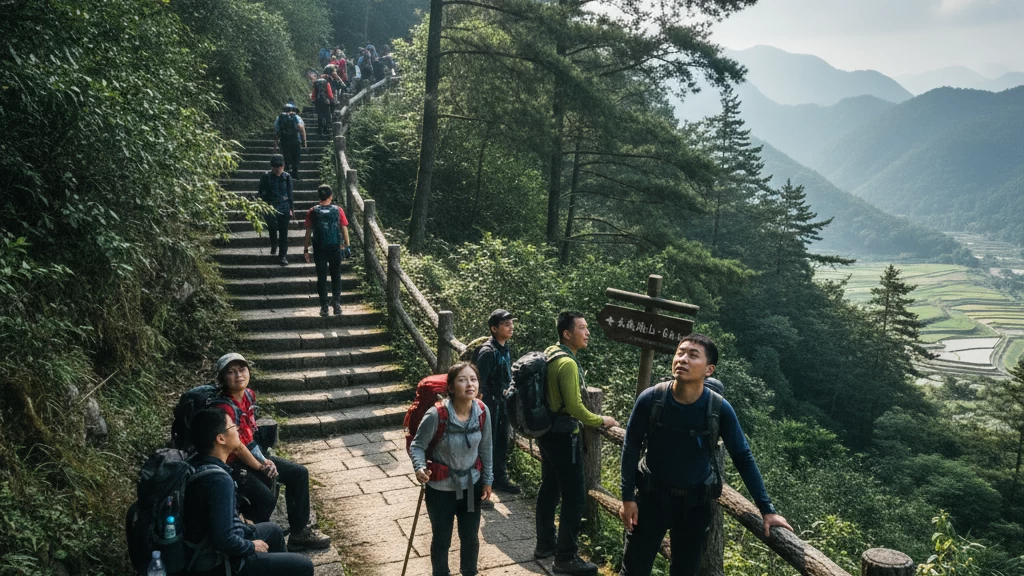
The number that really hits you isn’t the miles—it’s those 6,600 steps. That’s like doing a long, nonstop stair machine session, but outside, with humidity, crowds, and real-world gravity.
How Long Does It Take to Climb Mount Tai?
“How long to climb Mount Tai from Red Gate?” is usually the next question people ask.
Here are realistic timing ranges for a round trip on the classic route:
Ascent (Red Gate → Jade Emperor Peak):
- Fast and fit hikers/runners:
- 2.5–3.5 hours up with minimal breaks
- Average reasonably active traveler:
- 4–6 hours up, including photo stops, snack breaks, and catching your breath
- Untrained, sedentary, or carrying extra weight:
- 6–8+ hours up is common
- Some people take even longer and lean hard on railings the last part
Descent (summit → Red Gate):
- Fast and fit: about 2–2.5 hours down
- Average traveler: 3–4 hours down
- Knee-sensitive or tired: 4–5+ hours down, sometimes with many short rests
Full round trip for most people:
- Expect 7–10 hours total of movement and breaks if you hike up and down from Red Gate.
- That’s an all‑day effort, not a quick morning walk.
Mount Tai Difficulty vs a “Normal” Day Hike
To put Mount Tai into perspective for a U.S. traveler:
| Hike Type | Elevation Gain | Distance (round trip) | Surface | Relative Difficulty |
|---|---|---|---|---|
| Typical “moderate” US day hike | 1,000–2,000 ft | 4–8 miles | Dirt / mixed trail | Moderate |
| Steep, strenuous US day hike | 2,500–3,500 ft | 6–10 miles | Rocky trail | Hard |
| Mount Tai from Red Gate (up & down) | 4,200–4,600 ft | 8–11 miles | Stone stairs | Hard–Very hard |
What makes Taishan feel tougher than many American hikes:
- Elevation gain is big for a single push.
- Gain is packed into relentless stairs, not switchbacks.
- Downhill is punishing on the knees because it’s all steps, not sloped trail.
- Crowds and bottlenecks can make you stop and start instead of keeping an easy rhythm.
In fitness terms:
- If you’re comfortable doing 4–6 miles with 2,000–3,000 ft of gain on U.S. trails, Mount Tai will feel tough but manageable.
- If your typical “hike” is flat city walking or a short local trail, a full Red Gate–to–summit climb will feel like a serious challenge and may push you to the edge.
Bottom line: Yes, Mount Tai is hard to climb if you do the full Red Gate route, but the difficulty is very predictable. It’s you vs. stairs—6,600 of them.
How Hard Is Mount Tai Compared to Other Famous Climbs?
When people ask “how hard is Mount Tai,” they’re usually trying to compare it to other big-name hikes. On paper, the full Red Gate route is a long, steady stair climb with about 6,000+ stone steps and serious elevation gain, but it’s not technical and it’s at low altitude. Think of it as a very long stadium-stair workout rather than a dangerous mountain climb. If you want exact numbers on time and elevation, I break them down in detail in this guide to how long it takes to climb Mount Tai.
Mount Tai vs Huangshan (Yellow Mountain)
- Mount Tai is tougher on pure cardio and leg endurance; Huangshan usually feels shorter and more “scenic” than “grindy.”
- Huangshan has lots of ups and downs with varied paths; Mount Tai’s central route is a relentless uphill staircase.
- If you can handle a full-day stair day on Mount Tai, Huangshan’s main tourist routes will feel moderate.
- On a 1–10 difficulty scale for a reasonably fit person: Mount Tai ~7, Huangshan ~5–6.
Mount Tai vs Huashan (Hua Shan)
- Mount Tai is physically hard but not scary; Huashan adds exposure, drop-offs, and mental stress.
- Huashan’s famous plank walk and narrow ridges are far more intimidating; Mount Tai’s stairs are wide, solid, and busy.
- For people afraid of heights, Mount Tai difficulty is much easier to handle mentally than Huashan.
- Pure fitness load is similar, but Huashan feels
Mount Tai Fitness Level Required
Who can realistically hike Mount Tai from the bottom?
Mount Tai from the Red Gate is a serious stair climb: about 6,000+ stone steps and around 4–6 hours up for most people. You don’t need to be an athlete, but you do need:
- Decent leg strength and knee/ankle health
- Basic cardio fitness (you can walk 3–5 miles without feeling destroyed)
- Patience and mental grit to handle repetitive stairs
If you can walk up and down several flights of stairs without gasping for air, and you’re okay with a long, slow effort, you can realistically hike Mount Tai from the bottom.
Mount Tai for beginners and casual walkers
If you’re a casual walker who does:
- 6,000–10,000 steps a day
- Easy hikes of 3–5 miles on weekends
- Regular walks around the neighborhood
Then Mount Tai is “hard but doable” if you pace yourself.
Tips for beginners:
- Plan a full day. Don’t rush.
- Take a short break every 10–15 minutes in steep sections.
- Use trekking poles or rent a walking stick to protect your knees.
- Aim to reach the top before dark; start in the morning or early evening if doing a night climb for sunrise.
If you want a full route breakdown and options, the Central Route from Red Gate is explained clearly in this detailed Mount Tai hiking guide: Mount Tai hiking routes and tips.
Mount Tai for sedentary office workers with no training
If you:
- Sit at a desk most of the day
- Rarely exercise
- Get winded on a few flights of stairs
Then hiking Mount Tai from the bottom is still possible, but it will feel very tough.
Be honest with yourself:
- Expect lots of stops and heavy breathing.
- Your legs may shake on the steeper sections.
- The descent can be harder on your knees than the climb up.
If this is you, I’d recommend:
- Do 2–4 weeks of simple stair training before your trip (10–20 minutes a day).
- Consider starting from Midway Gate (bus + partial climb) instead of Red Gate.
- Absolutely avoid doing the whole climb in summer mid‑day heat.
If you’re very out of shape, have joint pain, or any heart/breathing issues, don’t feel pressured to do the full climb. Take the cable car, enjoy the views, and stay safe.
Mount Tai for kids, families, and older travelers
Mount Tai is popular with Chinese families, and you’ll see plenty of kids and seniors on the mountain, but not all of them walk from the bottom.
-
Kids (8–15 years old):
- Active kids who play sports can usually handle big chunks of the climb.
- Bring snacks, water, and plan for frequent breaks.
- Consider doing half hike + cable car to keep it fun, not miserable.
-
Young kids (under 7):
- The full climb from Red Gate is usually too much.
- Many parents either carry them for parts (which is exhausting) or use the bus and cable car.
- Be careful on crowded stairs; hold hands near edges.
-
Older travelers (60+):
- If you walk regularly and have decent knees, doing part of the main route is realistic.
- Many seniors hike from Midway Gate to South Heaven Gate and skip the low section.
- If you have heart issues, high blood pressure, or serious knee/hip problems, prioritize comfort and safety with the cable car.
For families and older travelers, I like to think of Mount Tai as modular: you can mix hiking, bus, and cable cars to match everyone’s ability and still enjoy the temples and views on top.
Who should skip the full climb and use the cable car instead?
You should seriously consider skipping the full Red Gate climb and using the bus/cable car if:
- You have:
- Knee, hip, or ankle problems
- Heart or respiratory issues
- Recent surgery or injury
- You’re significantly overweight and not used to any exercise
- You’re traveling with:
- Very young kids
- Elderly parents with limited mobility
- You hate stairs and already know they wreck your knees
The good news: taking the cable car doesn’t “ruin” the experience. You still:
- Walk a fair bit on top
- Visit temples and viewpoints
- Get the classic Mount Tai atmosphere without grinding through all 6,000+ steps
If you want to see exactly how the cable car and bus sections fit with the hiking segments, this overview of the main paths up Mount Tai explains the easiest and hardest options clearly: Mount Tai 2 main paths up and how to choose.
Bottom line:
- Full Red Gate climb: ideal for reasonably fit travelers, active beginners, and people who are okay with a long, tough stair day.
- Mixed hiking + cable car: ideal for most US travelers, families, and anyone who wants the experience without blowing out their knees.
- Cable car both ways: ideal for seniors, travelers with health issues, or anyone who just wants the view and temples without the grind.
Main Ways to Reach the Summit of Mount Tai
Mount Tai Routes to the Top (Quick Overview)
If you’re wondering how hard is Mount Tai to climb, it really comes down to which route you choose and how many stairs you’re willing to take on.
Here are the main ways up:
- Central Route from Red Gate (Red Gate → Midway Gate → South Heaven Gate → Jade Emperor Peak) – classic Mount Tai central route, about 6,000+ stone steps, the hardest and most famous way up.
- Half-hike + cable car – bus up to the middle area, then cable car to near the top, plus short walks.
- Bus + cable car combo – skip almost all of the stairs; this is the Mount Tai easiest route.
- Short summit walks – even if you ride the cable car, you’ll still walk some stairs and paths near the top to hit the main viewpoints.
If you want the full breakdown of the 6,600+ Taishan stairs count and where they are, I’ve mapped it in detail in this guide to the full breakdown of Mount Tai steps and sections.
Central Route from Red Gate Difficulty (Hardest Route)
The Mount Tai Red Gate route is the “real climb” and the toughest option:
- Distance & elevation: roughly 5–6 miles (8–10 km) one way with about 4,900 ft (1,500 m) of elevation gain.
- Time: most average hikers need 3.5–5 hours up, and 2–3 hours down.
- Difficulty: I’d rate this a 7–8 out of 10 for most casual American travelers, mostly because it’s endless stairs, not because of high altitude.
If you’re used to weekend hikes or stair workouts, you can do it with good pacing. If you’re sedentary or dealing with knee issues, this route will feel brutally repetitive and long.
Midway Gate and Eighteen Bends (Where It Gets Brutal)
On the central route, not all sections are equal. The steeper parts are what really define Mount Tai hike difficulty level:
-
Red Gate → Midway Gate to Heaven
- Mix of ramps and stairs, a steady uphill grind.
- You’re still feeling “OK” here; most people are tired but not destroyed.
-
Midway Gate to Heaven → Eighteen Bends (Shibapan)
- Stairs get steeper and more crowded.
- This is where a lot of people slow down and start asking “how hard is Mount Tai really?”
-
Eighteen Bends Taishan section
- Short but very steep, with tightly stacked steps.
- Expect burning calves, heavy breathing, and lots of rest stops.
- If your knees are sensitive, this is the part you’ll feel on the way down.
Past Eighteen Bends, the climb to South Heaven Gate feels more manageable mentally, because you know you’re close. From there, it’s a gentler walk with some stairs to Jade Emperor Peak.
Bus and Cable Car Route Difficulty and Comfort
If you don’t want to tackle all 6,600 steps, Mount Tai gives you “cheat” options:
-
Bus to Midway + cable car to South Heaven Gate
- Skips most of the climbing.
- You still walk a decent amount around the summit, including some stairs.
- Difficulty: 2–3 out of 10 for most travelers.
-
Bus to Tianwai Village → cable car → summit area
- Easiest Mount Tai route for seniors, families with kids, or travelers with knee issues.
- More time walking flat or gently sloped paths instead of grinding stairs.
The buses and cable cars are generally comfortable by U.S. standards, but expect crowds, lines, and some pushing on busy Chinese holidays. If you need a better feel for where these routes start from, my guide to Mount Tai’s location and trailhead access lays out the key entry points.
Which Mount Tai Route Fits Your Fitness Level?
Here’s how I usually match routes to different travelers:
-
Fitness enthusiasts / regular hikers
- Do the full Red Gate central route up.
- Option: hike up, cable car or bus down to save your knees.
-
Average active travelers (walk a lot, but don’t train hard)
- Consider half-hike + cable car.
- Start at Red Gate or Midway Gate, then ride up the steepest part.
-
Sedentary office workers, knee pain, overweight, or limited time
- Take bus + cable car both ways.
- Walk the summit paths at your own pace and still enjoy the views and temples.
-
Families with young kids or seniors
- Skip the full climb.
- Use the Mount Tai cable car option and pick short, scenic sections to walk together.
In simple terms: if you want to “earn it” and see how hard Mount Tai can feel, start from Red Gate. If your priority is enjoying the view and the culture without wrecking your legs, mix in the bus and cable car and keep the stairs under control.
Hour‑by‑Hour Mount Tai Route Breakdown
If you’re asking how hard is Mount Tai in real life, this hour‑by‑hour breakdown of the classic Central Route (Red Gate to Jade Emperor Peak) will give you a clear picture of what your body actually does on the mountain.
Red Gate to Doumu Palace (Hour 0–2)
-
What it feels like:
- Wide, steady stone steps starting right from Red Gate in Tai’an.
- Feels like a long city stair workout with temples, vendors, and snack stalls.
- You’re still low, so no altitude issues—just legs and lungs.
-
Distance & gain (rough):
- About 1.5–2 miles (2.5–3.5 km).
- Gradual but constant elevation gain.
-
Typical time:
- Fast hikers/runners: 45–60 minutes.
- Average walkers: 1–1.5 hours.
- Slow or frequent‑break walkers: 1.5–2+ hours.
This is where most U.S. travelers realize the Mount Tai steps are serious but still manageable if you’ve done some basic stair training. For a broader snapshot of the mountain layout and facilities, I keep an updated overview guide here: Mount Tai overview and routes.
Doumu Palace to Midway Gate to Heaven (Hour 2–4)
-
How the stairs change:
- Steps get steeper and a bit more uneven.
- Fewer flat rest sections between stair runs.
- Shade improves in parts, but it can still feel hot and humid in summer.
-
What to expect physically:
- Breathing gets heavier; quads start burning.
- You’ll stop more often, even if you’re fit.
- This is where a lot of casual visitors decide whether to keep pushing or switch to the bus/cable car combo later.
-
Typical time:
- Fast: 45–60 minutes.
- Average: 1–1.5 hours.
- Slow: 1.5–2+ hours with regular breaks.
By the time you hit Midway Gate to Heaven, most people feel like they’ve done a full workout already—and you’re only halfway.
Midway Gate to Heaven to The Eighteen Bends (Hour 3–5)
-
Stairs and route feel:
- Steps get more continuous and mentally tougher—fewer “easy” stretches.
- Path narrows in spots, so you may get stuck in slow stair traffic.
- Porters and other climbers moving both directions can break your rhythm.
-
Why it feels harder:
- You’re already tired, so even moderate stair angles feel steep.
- Heart rate stays high if you don’t pace yourself.
-
Typical time:
- Fast: 30–45 minutes.
- Average: 45–75 minutes.
- Slow: 1–1.5 hours if you sit down often.
This section is more about mental grind than raw difficulty; your legs are already warm (or fried), and you start wondering how long to the top.
The Eighteen Bends: Why It Feels Brutal (Hour 4–6)
The Eighteen Bends (Shi Ba Pan) is the iconic steep staircase near the top and the main reason many people rate Mount Tai as “tough but doable.”
-
What makes it so hard:
- Very steep, tight switchback staircase—basically a vertical stair master.
- Over 1,400–1,600 steps packed into a short distance.
- Almost no flat relief; every step is a climb.
-
How your body reacts:
- Calves and quads scream; this is where knee pain shows up for some people.
- You might move 10–20 steps at a time, then rest on the side.
- Heart rate spikes quickly if you try to power up too fast.
-
Typical time just for Eighteen Bends:
- Fast and very fit: 30–40 minutes with few breaks.
- Average hiker: 45–75 minutes with short pauses.
- Slow or untrained: 1–1.5 hours, sometimes more in crowds or heat.
If you want to know how Mount Tai difficulty changes with conditions (heat, rain, ice), I break that down in detail here: Mount Tai weather and seasonal conditions.
South Heaven Gate to Jade Emperor Peak (Final 30–60 Minutes)
Once you clear the Eighteen Bends and pass through South Heaven Gate, the hardest work is behind you.
-
How the terrain changes:
- Stairs are still there but much gentler.
- Short ups and downs as you walk through the summit area with hotels, shops, and temples.
- Paths are wider and more relaxed; crowds spread out.
-
How it feels:
- Your legs are tired, but the stress level drops a lot.
- More of a “victory lap” to Jade Emperor Peak than a true grind.
- Great spot to slow down, grab a snack, and enjoy the views if weather cooperates.
-
Typical time:
- Fast: 20–30 minutes.
- Average: 30–45 minutes.
- Slow and tired: 45–60 minutes with photo stops.
Realistic Total Times: Slow, Average, and Fast Climbers
For the full Mount Tai Red Gate route up to Jade Emperor Peak (not counting the descent):
-
Fast, very fit (run stairs, hike often):
- 2.5–3.5 hours up.
-
Average walker (reasonably active, some stairs in daily life):
- 4–5 hours up.
-
Slow or deconditioned (sedentary, extra weight, or knee issues):
- 5–7 hours up, sometimes longer in summer heat or heavy crowds.
Add another 2–4 hours to walk back down if you don’t use the cable car. Most U.S. travelers who do some stair training beforehand find Mount Tai hard but achievable in a day, especially if they respect the pace, rest often, and don’t rush the Eighteen Bends.
What Makes Mount Tai Feel Harder or Easier
Mount Tai difficulty isn’t just about the stats on paper. How hard Mount Tai feels comes down to your joints, the weather, and how well you handle crowds and repetitive effort.
Endless Stone Steps and Your Knees
Mount
Practical Tips to Make Climbing Mount Tai Easier
If you prep a bit and play it smart on the mountain, Mount Tai (Taishan) is tough but very doable for most people. Here’s how I’d approach it.
Best Time of Day and Season to Start Your Mount Tai Hike
Time of day (for most U.S. travelers):
- Start early morning:
- On-foot start from Red Gate: 5:00–7:00 a.m.
- Cooler temps, fewer crowds, less sun exposure.
- Sunrise / night climb:
- Take a late bus up to Midway Gate or South Heaven Gate, sleep near the top, then walk the last section for sunrise.
- Bring a headlamp, layers, and be careful on dark, uneven steps.
Best seasons for lower difficulty:
- Best: Late September–early November, late March–May
- Mild temps, less humidity, generally clearer views.
- Harder: June–August (summer heat & humidity)
- Expect to sweat heavily; need much more water, sunscreen, hat, and frequent rest.
- Hardest for footing: December–February
- Steps can be icy or snowy. You’ll want microspikes and gloves; otherwise, consider the cable car.
For updated operating hours and seasonal notes, I usually check a current resource like the Mount Tai travel guide site before locking in plans.
Simple Training Plan Before Your Trip (Stairs + Leg Strength)
Mount Tai is all about stairs. If you can handle long stair sessions, you’ll be fine.
4–6 weeks out (3x per week):
- Stair training
- 10–15 minutes of steady stairs at home, in your office building, or at a stadium.
- Gradually build to 30–40 minutes, with short breaks.
- Leg-strength basics
- 3 sets of bodyweight squats (10–15 reps).
- 3 sets of lunges (8–10 per leg).
- Calf raises on a step (3 × 15–20).
- Cardio
- 20–30 minutes of brisk walking, treadmill incline, or light jogging on non-stair days.
If you’re very sedentary:
- Start with flat walking 20–30 minutes daily.
- Add short stairs (5 minutes, then 10, then 15).
- The goal: you can climb 10–15 floors at an easy pace with breaks and still feel okay.
What to Pack and Wear for a Mount Tai Climb
Keep it light but smart. You don’t need hardcore backpacking gear, but you do need to be comfortable.
Footwear:
- Comfortable walking or trail shoes with good grip (running shoes with decent tread are fine).
- Skip new shoes; break them in before the
Mount Tai Cable Car Option and “Cheat” Routes
If you’re wondering how hard Mount Tai is and you’re not excited about doing all 6,600 Taishan steps, the bus + cable car routes are your best friends. You still get the Mount Tai experience, just without destroying your knees.
How the Mount Tai Bus and Cable Car System Works
There are three main ways people “cheat” Mount Tai:
-
Central Route + Bus + Cable Car (Most Popular for U.S. Travelers)
- Taxi or rideshare to the Tianwai Village tourist center.
- Shuttle bus up to Zhongtianmen (Middle Gate).
- Cable car from Zhongtianmen → South Heaven Gate (Nantianmen).
- Hike a short final section to Jade Emperor Peak.
-
Backside Route via Taohuayu (Peach Blossom Valley)
- Bus up the back of the mountain.
- Cable car from Taohuayu → South Heaven Gate.
- Same short walk to the summit.
-
Hike Half + Cable Car Half
- Start at Red Gate, hike to Zhongtianmen.
- Take the cable car the rest of the way.
- Good middle ground if you want to test your fitness but skip the worst of the stairs.
All routes are well-marked, ticketed, and set up for tourists. You don’t need Chinese to figure it out, but having screenshots of route maps on your phone helps.
Mount Tai Cable Car Costs, Hours, and Queues
Prices change a bit over time, but here’s the ballpark you should plan around (per person, one-way):
- Shuttle bus: usually around RMB 30–40
- Cable car (Zhongtianmen or Taohuayu lines): around RMB 100–130
You’ll also pay the main Mount Tai entrance ticket separately.
Operating hours:
- Buses: roughly from early morning until late afternoon.
- Cable cars: typically daytime only, often from 7:00 or 8:00 a.m. to around 5:00 p.m., sometimes longer in peak season.
I always tell people from the U.S.:
- Do not assume the cable car runs for sunrise or late-night descents.
- Confirm same-day hours at the ticket office or online before you commit to a sunrise or night climb.
Queues:
- Expect long lines during:
- Golden Week (early October),
- Labor Day (early May),
- Summer weekends,
- Clear-sky holidays.
- If you want shorter waits:
- Go early in the morning.
- Avoid Chinese national holidays.
- Aim for shoulder seasons (spring/fall weekdays).
How Much Hiking You Still Do with the Mount Tai Cable Car
Even if you “cheat,” you don’t just step off the cable car and touch the summit.
- From South Heaven Gate → Jade Emperor Peak, you still walk:
- Roughly 20–40 minutes depending on your pace.
- Mostly stone steps, some gradual, some steeper.
- You’ll still be:
- Walking uphill at elevation (~1,500 m / ~4,900 ft, no real altitude sickness risk for most people).
- Navigating uneven stone, which can bother knees and ankles.
If you take:
-
Bus + cable car both ways:
- Effort level: like a short city hill walk.
- Most U.S. travelers, even sedentary ones, can handle this if they’re okay walking 1–2 miles on stairs over a couple of hours.
-
Hike to Zhongtianmen + cable car up:
- You’ll still do a few thousand steps and feel like you worked for it.
- This is a good option if you want to say you “climbed Mount Tai” without wrecking yourself on the Eighteen Bends.
Pros and Cons of Mixing Hiking with Bus or Cable Car
Pros:
- Saves your knees – Those endless Taishan stone steps are brutal on joints, especially for U.S. travelers not used to daily stair climbing.
- More control over your day – Easier to time sunrise, sunset, or squeeze the trip into a short itinerary.
- More accessible – Works better for:
- Families with kids
- Older travelers
- Overweight or untrained visitors
- Anyone recovering from knee or ankle issues
- You still get the views and temples without hitting all 6,600 steps.
Cons:
- Less sense of “I conquered Mount Tai” if you’re a type‑A hiker.
- Crowded waiting areas at bus and cable car stations during peak times.
- Less flexibility at night – if you miss the last cable car, you’re walking down or staying on the mountain.
If your main goal is landscape + culture + photos, and not suffering, the combo approach makes way more sense.
How to Still Feel You “Earned It” Without All 6,600 Steps
You don’t have to grind every single step to feel like you did Mount Tai the “right” way. Here’s how I’d structure it for most people from the U.S.:
Option A – “I worked for this, but I’m not dying” (Moderate)
- Hike from Red Gate → Zhongtianmen (lots of steps but totally manageable if you’re patient).
- Take the cable car to South Heaven Gate.
- Walk the final section to Jade Emperor Peak.
- Cable car + bus back down.
Option B – “I want the views, not the pain” (Easy)
- Bus to Zhongtianmen.
- Cable car to South Heaven Gate.
- Walk to the summit, explore temples, enjoy the views.
- Reverse on the way down.
Option C – “Mini challenge” (Light but still meaningful)
- Take bus + cable car up.
- Spend time walking around the summit area:
- Explore side paths, temples, and view platforms.
- Add short climbs and stairs.
- Walk back to the cable car after 1–2 hours of exploring.
If you want it to feel earned:
- Carry a small daypack (water, layers, snacks).
- Walk every viewpoint you can reach up top.
- Treat it like a real hike at the summit, not just a cable car photo op.
You’ll still be able to say honestly:
“I climbed Mount Tai” – you just did it smarter, not harder.
Hardest Times and Seasons to Climb Mount Tai
Chinese Holidays and Peak Crowd Days to Avoid
If you’re asking “how hard is Mount Tai,” crowds are a big part of the answer. The stairs themselves are one thing; being stuck in a human traffic jam is another.
I avoid these dates as much as possible:
- Chinese New Year (late Jan–Feb, exact dates vary) – Some days are quiet, but key days can be packed.
- Qingming Festival (around early April) – Taishan is a major cultural and spiritual site, so it gets busy.
- Labor Day “Golden Week” (around May 1, usually May 1–5)
- National Day “Golden Week” (Oct 1–7) – This is the worst for crowds.
- Summer school holidays (July–August weekends)
On these days, Mount Tai difficulty jumps from the stairs themselves plus:
- Long ticket and bus lines
- Stair “traffic jams,” especially around Midway Gate to Heaven and Eighteen Bends (Eighteen Turns)
- Extra mental fatigue from stop‑and‑go walking and noise
If your schedule is fixed, go:
- Very early (pre‑dawn for a Mount Tai sunrise hike or night climb)
- Or later in the evening to miss tour groups
Summer Heat, Humidity, and Midday Sun
Summer is when a lot of U.S. travelers visit, but it’s also when Mount Tai can feel brutal.
From June through August, expect:
- High heat and heavy humidity – you’ll sweat hard even at a slow pace
- Strong midday sun on exposed stone steps
- Higher risk of heat exhaustion and dehydration
To keep “Mount Tai difficulty” from jumping a few levels in summer:
- Start before sunrise or after 6–7 pm for a night climb
- Wear light, moisture‑wicking clothing and a hat
- Bring at least 2–3 liters of water per person (you can buy more on the mountain, but prices are higher)
- Take short breaks in shade; don’t try to power through the steepest parts in the midday window
Winter: Snow, Ice, and Slippery Steps
Winter on Mount Tai (roughly December–February) is a different kind of hard.
You may face:
- Ice and packed snow on the stone steps
- Very cold wind, especially near South Heaven Gate and the summit
- Higher risk of slips and falls, especially on the way down
If you’re not used to winter hiking, Mount Tai in full winter conditions can feel more serious than the stats suggest.
If you do go in winter:
- Wear traction aids / microspikes if there’s visible ice
- Use a hiking pole or rented walking stick for balance
- Dress in layers (base, mid, shell) and protect your hands and ears
- Consider bus + cable car instead of climbing 6,000+ icy steps
Spring and Autumn: Pros and Cons for Difficulty
From a pure “how hard is Mount Tai to climb” angle, spring and fall are the sweet spots, but they’re not perfect.
Spring (March–May):
- Pros: Cooler temps, flowers, more comfortable climbing weather
- Cons:
- Early spring can still be chilly and windy
- Qingming and May 1 holidays spike crowds
- Rainy days can make stone steps slick
Autumn (September–November):
- Pros:
- Generally the best conditions – clear air, moderate temps
- Less humidity than summer
- Cons:
- National Day Golden Week (Oct 1–7) is extremely crowded
- Late fall can be quite cold and windy near the summit
Best Months and Time Window for a Comfortable Climb
If your goal is to keep the Mount Tai hike difficulty manageable and still have a good experience, here’s what I recommend:
Best overall months for most U.S. travelers:
- Mid‑March to late May (avoid Qingming and May 1)
- Mid‑September to late October (avoid Oct 1–7)
Best time of day to cut difficulty:
- Start 3–5 am if you want a sunrise hike and cooler temps
- Start late afternoon / early evening for a night climb with cooler air and fewer tour groups
- Avoid 10 am – 3 pm for long, exposed sections in summer or warmer days
In simple terms:
- Weather + crowds matter as much as elevation gain.
- The same Mount Tai central route from Red Gate can feel like a 5/10 or a 9/10 depending on season, heat, crowds, and time of day.
Plan around those four factors, and the climb becomes a lot more doable, even if you’re not in peak hiking shape.
Real Mount Tai Difficulty Stories
Families with kids on Mount Tai
From what I’ve seen and heard from American families, Mount Tai (Taishan) is very doable with kids, as long as you’re realistic:
-
Kids 8–12:
- Most grade‑school kids with normal fitness can handle big sections of the Taishan stairs.
- Many families start at Red Gate, hike to Midway Gate to Heaven, then switch to the bus and cable car.
- Parents say the main challenges are:
- Endless steps (kids get bored more than tired)
- Crowds and needing to hold hands on narrow sections
- Cold wind at the top if you’re up for sunrise
-
Young kids (4–7):
- Most families report these kids don’t make it from Red Gate all the way to the top on foot.
- Common strategy:
- Bus + cable car up
- Let the kids walk the flatter summit area near South Heaven Gate and Jade Emperor Peak
- Strollers are a no-go on the stone steps; carriers can work but feel heavy on steep parts.
-
What parents tell me they wish they’d known:
- The “fun” factor matters more than the “fitness” factor for kids. Snacks, breaks, and small rewards keep them going.
- The Taishan stone steps can get slippery in rain or fog, so grippy shoes for kids are a must.
- Night climbs for sunrise are romantic in theory, but with kids most say it’s too tiring and cold to be worth it.
Bottom line: Mount Tai for families is absolutely possible, but I’d mix hiking with the cable car. I would not push kids to do all 6,600 steps from Red Gate unless they’re unusually strong and motivated.
Active seniors and 60+ hikers on Taishan
Mount Tai for seniors depends a lot on your baseline fitness, not your age on paper:
-
Fit 60+ hikers:
- Retired runners, regular walkers, and people used to local stairs or hills in the US (think daily 10,000+ steps or frequent hikes) usually describe Taishan as “tough but doable.”
- Many in this group complete Red Gate to South Heaven Gate in 4–6 hours with many breaks.
- Knees and calves usually hurt more on the way down than the way up. Several seniors choose to hike up and then take the cable car down to save their joints.
-
Less active seniors:
- Frequent feedback: “The stairs just never end.”
- Many choose:
- Bus + cable car up
- Slow walk around the summit area, then cable car down
- They still feel they “climbed Mount Tai,” without the risk of overdoing it.
-
What seniors wish they’d known:
- Trekking poles or walking sticks (you can rent or buy them near the base) make a big difference on the stairs.
- It’s not about altitude sickness (Mount Tai’s elevation is moderate); it’s about repetitive stone steps and long time on your feet.
- Layers matter. Even if Tai’an city feels warm, the top can be windy and cold, especially at sunrise.
If you’re an older traveler from the US and can handle a few flights of stairs without getting wiped out, you can enjoy Mount Tai, but I’d seriously consider using at least one cable car leg.
Overweight or untrained travelers’ honest feedback
This is the group that usually asks, “How hard is Mount Tai really?” and the honest answer: if you’re untrained, it’s hard, but not impossible if you plan smart.
What overweight or sedentary travelers commonly report:
- The first third (from Red Gate up to roughly Doumu Palace/Midway area) already feels like a workout.
- Heart rate spikes on the steeper stair sections, and people need frequent breaks.
- Quads and knees start burning hard before the Eighteen Bends.
Common strategies that work well:
- Start late afternoon or at night for a sunrise hike to avoid heat and sun exposure.
- Set micro-goals:
- One shrine to the next
- One rest area to the next
- Many untrained travelers don’t actually finish all the way from Red Gate; they:
- Hike partway
- Then hop on a bus + cable car to finish the climb
What they wish they’d known:
- You don’t have to prove anything. Mixing hiking with the cable car is normal; locals do it too.
- Doing basic stair training (even just 10–15 minutes a few times a week in your apartment building or office stairwell) for 3–4 weeks before your trip makes a massive difference.
- The mental fatigue is real. Stairs after stairs can feel endless, so music, podcasts, or hiking with a friend helps a lot.
If you’re overweight or untrained and coming from a mostly seated U.S. lifestyle, I’d rate the full Red Gate route as “very hard.” But a mixed route (some hiking + cable car) is very achievable and still feels rewarding.
How experienced hikers and runners rate Mount Tai difficulty
People who are used to hiking or running in the US (think national parks, local trails, 5Ks, half marathons) tend to see Mount Tai differently:
-
Trail runners & strong hikers:
- Many call Mount Tai “a huge stair workout, not a technical hike.”
- They often finish from Red Gate to the summit in 2.5–4 hours if they keep a steady pace and don’t get stuck in crowds.
- Most say their biggest complaint is knee and calf fatigue, not running out of breath.
-
Experienced but casual hikers (weekend warriors):
- Rate the full Red Gate route around 7–8/10 for difficulty, mainly because of:
- 6,000+ stone steps
- Steep Eighteen Bends section
- Long time grinding uphill
- Many still recommend at least hiking the last tough section (Eighteen Bends) instead of skipping it with the cable car, because that’s the most memorable part.
- Rate the full Red Gate route around 7–8/10 for difficulty, mainly because of:
-
How they compare it to US hikes:
- Harder on the legs than most “normal” day hikes in U.S. national parks because the stairs are constant.
- Less risky than exposed trails like Angels Landing or Half Dome; there’s very little cliff exposure on the main Taishan route.
- Lower altitude than big Colorado hikes, so fewer breathing issues from thin air.
For fit hikers and runners, Mount Tai is more of a “stair challenge” than a technical mountain, but it’s still tough enough to feel like an achievement.
What most people wish they had known before climbing Mount Tai
Across all ages and fitness levels, a few themes come up over and over:
-
It’s not just a “walk in the park.”
- The words “tourist mountain” make it sound easy, but 6,600+ steps and serious elevation gain will test your legs, especially if you’re not used to stairs.
-
The descent can be rougher than the climb.
- A lot of people say their biggest regret is walking all the way down instead of taking the cable car, because the constant descending beats up your knees.
-
Start earlier or later, not in the midday sun.
- Many American travelers underestimate how intense the summer heat, humidity, and sun feel in Shandong.
- Early morning or evening/night climbs feel dramatically more comfortable.
-
Crowds change the experience.
- On holidays and weekends (especially Golden Week, Labor Day, and summer weekends), the stairs clog up and your pace may be forced to “stop and go.”
- That can make Mount Tai feel harder and more tiring mentally.
-
You don’t need fancy gear, but you do need the basics:
- Real sneakers or light hiking shoes with grip
- Light layers + a windbreaker up top
- 1–2 liters of water per person to start, plus cash or mobile pay for buying drinks and snacks on the way
If I had to sum up the real Mount Tai difficulty in plain talk: it’s absolutely manageable for most U.S. travelers with basic fitness if you respect the stairs, pace yourself, and use the bus or cable car when you need to. The people who struggle the most are the ones who show up in casual street shoes, start at noon in summer, and assume it’s just a short tourist stroll.
Final Verdict: How Hard Is Mount Tai Really?
Mount Tai difficulty rating (Red Gate route)
If you hike Mount Tai from the Red Gate all the way to Jade Emperor Peak, I’d rate the Mount Tai difficulty as:
- 7–8 out of 10 for the average traveler
- About 5–6 out of 10 if you’re already fit and used to stairs or hiking
- 9 out of 10 if you’re sedentary, overweight, or have knee issues
Why?
- Around 6,600 stone steps
- Roughly 4–5,000+ ft (1,200–1,400 m) elevation gain
- Most of it is relentless, steep stairs, especially from Midway Gate to Heaven and the Eighteen Bends
It’s not a technical climb, but it’s tiring, repetitive, and tough on knees and calves.
Difficulty rating with bus + cable car
If you mix bus and cable car, the Mount Tai hike difficulty level drops a lot:
- Bus + cable car, then short walk to Jade Emperor Peak:
- 3 out of 10 – light walking at altitude, still some stairs but nothing wild
- Bus + partial hiking (skip lower section, walk from Midway Gate or South Heaven Gate):
- 4–6 out of 10 depending on how much you walk
You still:
- Get great views
- Deal with some stairs
- Feel like you “climbed” Mount Tai, just not every step from the bottom
Who should hike Mount Tai from the bottom
I strongly recommend the full Red Gate route for:
- Active hikers and runners
- Gym regulars who do legs, squats, or stair machine
- Anyone who enjoys endurance challenges and wants to say, “I climbed all the way up Taishan”
- Travelers in decent shape who don’t have serious knee or heart issues
If you like pushing yourself and you’re okay with being sore the next day, the full Mount Tai central route is absolutely worth it.
Who should choose easier Mount Tai routes
You’re better off taking bus and/or cable car if:
- You’re a sedentary office worker with no training
- You have knee pain, back issues, heart or breathing problems
- You’re significantly overweight and not used to long stair climbs
- You’re traveling with younger kids, older parents, or first-time travelers who tire quickly
- You just want views, temples, and the Mount Tai vibe without wrecking your legs
In that case, use:
- Bus up + cable car + short walks
- Maybe hike a small section to experience the famous Taishan steps without doing all 6,600.
Is Mount Tai worth it for first‑time visitors to China?
For a first trip to China, yes – Mount Tai is worth the effort, even if you don’t hike from the very bottom.
Here’s how I’d frame it for a US traveler:
- If you like national parks, long day hikes, or places like Yosemite, Zion, or Grand Canyon, then climbing from Red Gate will feel like a meaningful, memorable challenge.
- If you’re more of a “see the highlights, not kill my legs” traveler, then bus + cable car + short walks is the sweet spot. You still get:
- The UNESCO site
- Historic temples and stone inscriptions
- Big views and the classic Mount Tai sunrise or sunset feel
Bottom line:
- Full Red Gate route – do it if you’re reasonably fit and want a serious, stair-heavy workout with big bragging rights.
- Mixed bus/cable car routes – do them if you want the scenery and culture without turning your vacation into a sufferfest.
- Either way, Mount Tai is one of the most iconic climbs in China, and it deserves a spot on a first‑time China itinerary.